

Introduction
In the complex ecosystem of commercial construction, the terms “storefront sytsem” and “window wall” are often used interchangeably by real estate agents and novice developers. However, for a General Contractor (GC) or a Procurement Manager responsible for a multi-million dollar façade package, confusing these two systems is a critical error.
⚖️ Two Systems, Fundamentally Different Purposes
While both are glazing systems that span floor-to-floor, they are engineered for fundamentally different purposes.
- 🔹 One is designed to welcome foot traffic at the ground level with integrated entrances.
- 🔹 The other is engineered to maximize living space in high-rise residential towers while managing slab-edge waterproofing risks.
⚠️ Why It Matters
The choice between storefront vs window wall dictates your building’s thermal performance, water management strategy, installation schedule, and long-term maintenance costs.
🗺️ In this comprehensive 2026 guide…
Drawing from APRO’s extensive manufacturing experience across global markets—from the bustling streets of Shanghai to the skylines of North America—we will dissect the storefront vs window wall difference with surgical precision.
We will move beyond the definitions to explore the storefront vs window wall cost drivers, structural limitations, and the nuanced “Podium-to-Tower” transition details that often become litigation hotspots.
✅ Whether you are specifying a storefront system for shopping mall entrances or deciding when to use storefront vs window wall for a mixed-use podium, this guide serves as your definitive decision framework.
What is a Storefront System?
🏢 The Baseline Definition
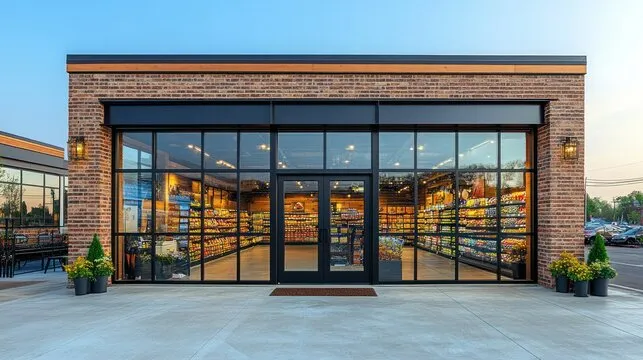
In the simplest terms, a storefront system is a non-load-bearing glazing system designed primarily for ground-floor applications. It is the workhorse of retail. When you walk into a Starbucks, a CVS, or a local boutique, you are likely walking through a storefront system.
⚙️ The Engineering Reality
Technically, a storefront system explained involves an aluminum frame that is anchored between the floor slab and the structure above. It is “center-glazed,” meaning the glass sits in the middle of the aluminum extrusion.
🔑 Key Characteristics
- 🔹 Height: typically limited to 10-12 feet (spanning one floor).
- 🔹 Water Management: Uses a sill flashing to catch water and weep it out. It is not designed to be completely waterproof at high pressures.
- 🔹 Usage: High traffic entrances, retail displays.
If you are searching for the storefront system meaning, think of it as “The Retail Standard.” It prioritizes maximizing glass area for product display and integrating heavy-duty doors for constant foot traffic.
🔗 Internal Link: What is a Storefront System?
What is a Curtain Wall System?
🌆 The Core Concept

A curtain wall system is a non-structural exterior façade that hangs from a building’s main frame, providing weather protection and architectural appearance. It is especially suitable for high-rise buildings because it can accommodate wind loads and building movement while remaining relatively lightweight.
🏗️ The Structural Difference
A curtain wall framing system explained reveals that it supports its own dead load and transfers wind loads back to the main building structure, usually at the floor lines.
- 🔹 Continuous: It creates a continuous façade, covering the slab edges.
- 🔹 Water Management: It utilizes a sophisticated pressure-equalization system (we will cover curtain wall pressure equalization vs storefront later).
- 🔹 Height: Unlimited. It can span 100 stories.
When clients ask about curtain wall vs storefront system overview, I tell them:
🔗 Internal Link: What is a Curtain Wall?
Where They Are Used (Typical Application Scenarios)
Choosing between storefront vs curtain wall depends entirely on the “Use Case.” Let’s break down the three most common battlegrounds.
🛍️ Retail street front / mall storefronts
For the ground floor, storefront vs window wall for retail storefront discussions usually end with Storefront winning. Why?
- 🔹 Entrances: Storefront profiles are engineered to accept heavy door closers and pivots. A window wall or curtain wall profile is often too bulky or not designed for the torque of a door opening 500 times a day.
- 🔹 Cost: For a standard 10-foot span, the storefront system for shopping mall entrances is the most cost-effective solution.
- 🔹 Visibility: The storefront glazing system overview prioritizes clear sightlines for merchandise.

We recently supplied a storefront system for restaurant front in Miami. The client considered window wall, but the need for a seamless integration with ADA-compliant doors made storefront the only logical choice.
🏢 Office towers / high-rise façades
Once you go above the third floor, the conversation shifts to storefront vs window wall for high rise buildings.
🚫 The Rule:
You generally do not use storefronts on high-rises. The wind loads are too high, and the water management isn’t robust enough.
⚖️ The Choice:
It becomes curtain wall vs window wall for office towers.
- 🔹 Window Wall: Sits between slabs (like a storefront) but is engineered for higher performance.
- 🔹 Curtain Wall: Hangs outside the slab.
If you are building a 40-story tower, you are likely debating window wall vs curtain wall high rise (which to choose). Curtain wall offers the best aesthetic (all glass look), while window wall is often cheaper but exposes the slab edge (requiring aluminum covers).
🔄 Podium-to-tower transition
This is the danger zone. This is where architects ask about storefront vs curtain wall at ground floor transitions.
Imagine a building with a 2-story retail podium (shops) and a 20-story residential tower above.
The Mix:
You might use a storefront system for curtain wall transition at ground floor.
The Risk:
The differential movement. The tower settles differently than the podium. If you rigidly connect a storefront vs window wall at podium level, the glass will shatter.
✅ Pro Tip: When detailing a ground floor storefront upper floor curtain wall transition, always use a dedicated expansion receiver. Do not caulk them together and pray.
System Anatomy (Structural Composition Differences)
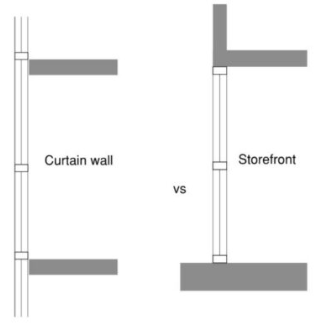
If you want a real storefront vs curtain wall comparison, stop looking at the glass first—look at what carries the load, how water is controlled, and how the system survives building movement. Think of this section as putting on X-ray glasses: we’re going to follow the forces and the water, not the marketing names.
🏗️ Framing & Load Path (Who Holds What—and Where the Loads Go)
Storefront (typically in punched openings / ground floors):
Storefront framing is usually perimeter-supported—meaning the verticals and horizontals are fastened to the surrounding structure at the head/jamb/sill. In most storefront framing vs window wall framing comparisons, storefront members are lighter and shallower, because they’re not meant to manage multi-story wind suction the way a true curtain wall does.
- 🔹 Typical condition: anchored to opening framing, not hung off slab edges
- 🔹 Best for: low-to-moderate heights, retail podiums, interior-exterior storefront lines
Curtain Wall (hung off slab edges, spanning floors):
Curtain wall is a building-skin system. The mullions are connected to the structure through engineered anchors at slab edges, and the load path is designed for significant wind suction/pressure, plus floor-to-floor movement.
- 🔹 Typical condition: anchors/embeds/brackets at slab edge
- 🔹 Best for: high-rise façades, large spans, higher performance demands
🧠 Quick mental shortcut:
✅ Storefront = supported by the opening frame
✅ Curtain wall = hung from slabs and designed as a continuous exterior skin
💧 Water Management (Drainage vs Pressure Equalization—the “Weep” Reality)
This is where systems that look similar on paper behave totally differently in the field.
- 🔹 Storefront water logic = drained by gravity (simple internal drainage):
Most storefront systems assume that some water will get past the exterior gasket. The design goal is to collect it and drain it out via internal gutters and weep holes. This works well when wind pressures are modest and the water path remains controlled. - 🔹 Curtain wall water logic = pressure-equalized rain screen (higher performance strategy):
A well-detailed curtain wall typically uses a multi-line seal + drained/ventilated chamber approach. The goal is not just to “drain water out,” but to remove the pressure difference that drives water inward. No pressure difference = much less force pushing water through imperfections.
🏭 Factory / Mock-up Experience (why weeps can betray you)
On a project where the client wanted to save budget, we tried to push a storefront-style detail into a higher-wind condition. In the mock-up water penetration test (ASTM E331), weep holes that normally behaved like harmless drains started acting like pressure outlets—you could literally hear them “whistle” as the pressure ramped. The water didn’t just “leak”; the pressure changes drove water where gravity-drain logic wasn’t enough.
What we changed (the fix that actually worked):
We stopped treating it like a storefront drainage problem and redesigned that elevation with a window wall approach—deeper receivers, a more reliable drained cavity strategy, and detailing that behaves closer to a rain-screen concept (i.e., controlling pressure and directing drainage intentionally, not hoping gravity alone saves you).
Takeaway: Storefront = “Let some water in, then drain it” vs. Curtain wall = “Don’t let pressure push water in”
↔️ Movement Accommodation (Interstory Drift, Slab Deflection, and the “Crush Zone”)
Buildings move—more than most buyers expect. Concrete shrinks, floors deflect under load, towers sway, and temperature cycles expand/contract the frame. The system that survives is the system designed to absorb movement without turning glass and seals into sacrificial parts.
- 🔹 Storefront (lowest movement tolerance):
Storefront is often the most vulnerable to floor deflection and interstory movement, especially when it’s installed tight to structural edges with limited receiver depth. If the slab above deflects or the opening changes shape, the storefront can get pinched, which leads to cracked glass, gasket failure, or persistent water intrusion. - 🔹 Curtain wall (engineered movement strategy):
Curtain wall systems are typically designed with slip joints, stack joints, and anchor strategies that allow floors to move independently while the façade maintains continuity. Movement is expected, so the system is built to accommodate it.
Performance Comparison

Here is the data-driven breakdown of storefront vs window wall structural performance and other key metrics.
(All values are typical ranges and must be confirmed by the selected system’s test reports and project specs.)
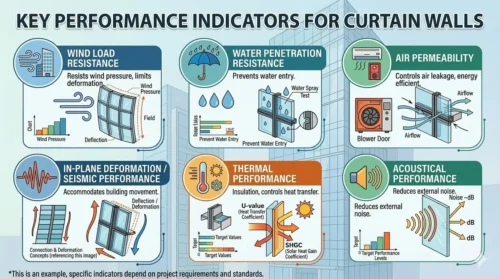
🏗️ Structural Performance (Design Pressure / Wind Load)
Design pressure is the first filter. If a system can’t meet the required wind load, nothing else matters.
- 🔹 Storefront: In many typical applications, storefront systems often sit in a lower design-pressure band—commonly referenced around 30–40 PSF for standard conditions (system/project dependent).
- 🔹 Curtain wall: For high-rise / hurricane / coastal projects, curtain wall design pressure capacity is commonly specified much higher, and can be written to 80–100+ PSF in demanding zones (system/project dependent).
🚩 Takeaway: If your project is high-rise or high-wind, storefront is often eliminated early unless the system is specifically engineered and tested for the requirement.
💨 Airtightness & Watertightness (Air/Water Leakage Behavior)
Air and water performance are where “looks similar” systems start behaving very differently. Storefront vs window wall air leakage becomes an energy bill issue and a comfort issue (drafts, condensation risk).
- 🔹 Storefront reality: Storefronts are comparatively “leakier” in real-world execution—especially when fast-installed with minimal perimeter air-barrier continuity. Under higher pressures, storefront-style details are more likely to struggle unless carefully designed and tested.
- 🔹 Window wall reality: Window walls are often rated higher than storefronts, but slab-edge leakage is a common failure point if the perimeter sealant/air barrier transition is weak.
- 🔹 Curtain wall reality: Higher-end curtain wall systems typically have better-defined strategies for air/water control (multi-line seals, drained/ventilated cavities, pressure moderation strategies—depending on system).
🚩 Takeaway: Window wall may “rate higher,” but slab-edge detailing decides whether it performs as designed.
🌡️ Thermal Performance (U-Factor / SHGC / Thermal Bridging)
If the question is energy performance, the frame design and thermal break strategy matter as much as the glass.
- 🔹 Window wall often wins on typical projects because it’s frequently specified with more robust thermal-break strategies and better alignment with the building envelope continuity (when detailed well).
- 🔹 Thermally broken storefront exists, but many storefront series use simpler thermal-break solutions that may not match high-performance façade targets.
- 🔹 High-end systems (window wall and curtain wall) may use wide polyamide struts or more advanced thermal-break designs that significantly reduce heat transfer compared with basic breaks.
🚩 Takeaway: “Thermal break” is not a yes/no item—the thermal break type and continuity determine real performance.
🔇 Acoustic Performance (STC / OITC)
For hotels near airports or noisy urban sites, acoustics can be the deciding factor. STC/OITC depends on both glass + frame leakage.
- 🔹 Curtain wall often performs better in demanding acoustic targets because it may allow thicker assemblies and can reduce interior-exposed joint complexity (project/system dependent).
- 🔹 Storefront limitation: Even with acoustic laminated glass, storefront frame/joint leakage can limit the practical STC/OITC improvement.
🚩 Takeaway: If you need high acoustic ratings, you must control air leakage first, not just buy “better glass.”
🛡️ Security & Impact (Hurricane / Blast / Forced Entry)
Both storefront and window wall can be engineered for high-security or impact-rated requirements—but the anchorage strategy becomes critical.
- 🔹 Impact-rated storefront vs window wall: Both can meet demanding codes in some engineered configurations, but storefront anchorage (often relying on anchors into concrete/openings) can become a weak link if not designed and installed to the same rigor as higher-end façade systems.
- 🔹 Curtain wall advantage: Curtain wall anchorage commonly uses more robust slab-edge attachment strategies and engineered brackets/embeds depending on structure and design intent.
🚩 Takeaway: Security is rarely “glass-only.” It’s glass + frame + anchorage + substrate.
📝 Note on Testing Language (important for accuracy)
ASTM E283 is the test method used to measure air leakage rate—it does not “set” the allowable limit by itself.
In practice, many project specs use targets like 0.06 cfm/ft² for baseline performance, while high-performance façade specs may push lower (e.g., 0.03 cfm/ft² or below), depending on the project and system.
Height Limitation & Rules of Thumb (Storefront vs Curtain Wall)
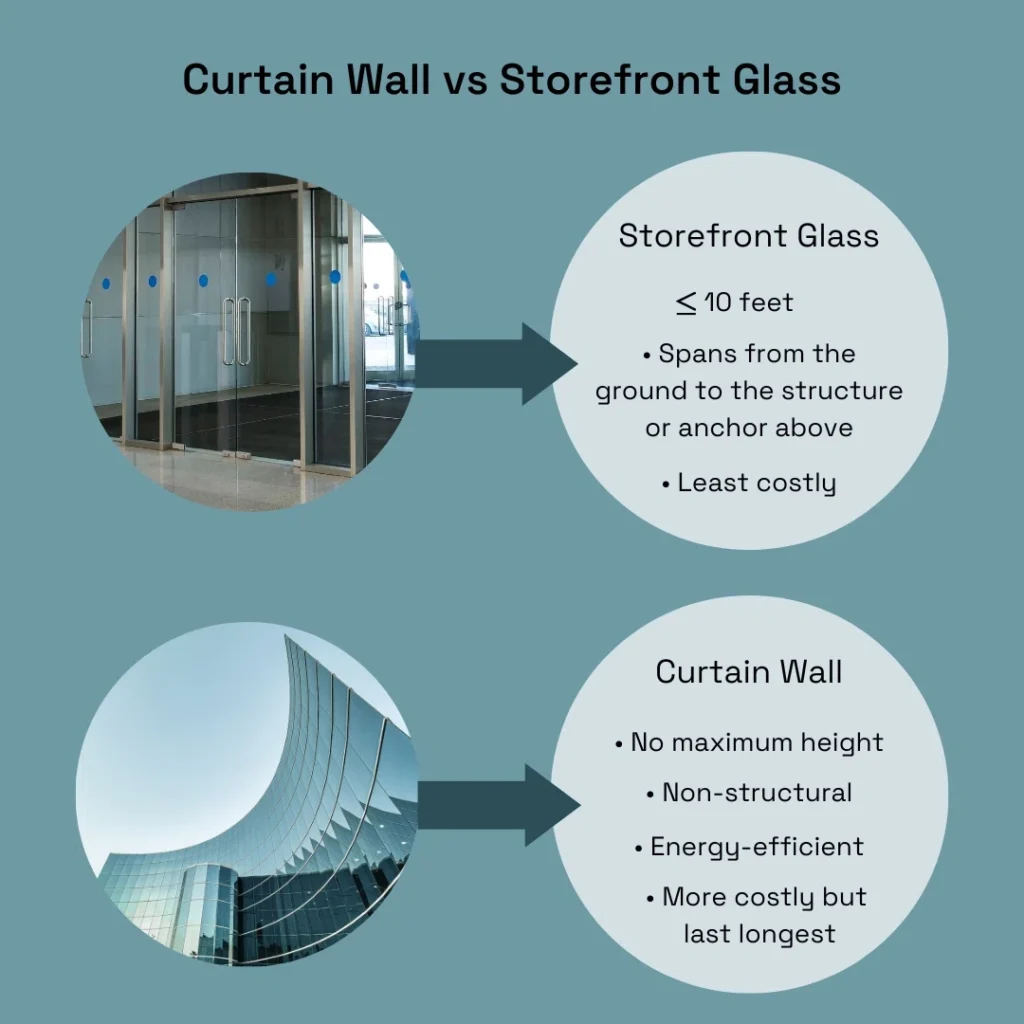
When people ask “How tall can this system go?” what they really mean is: Can it meet the required wind load, water resistance, movement, and anchor capacity at that height—reliably, not just on paper?
Below are practical rules of thumb used in early design—only comparing storefront and curtain wall.
⚖️ The Core Rule
- 🔹 Storefront is typically a low- to mid-rise opening system.
- 🔹 If the façade is expected to behave like a continuous exterior skin across floors, curtain wall is usually the default.
🏢 Storefront Height Limit (Rules of Thumb)
Use storefront when the glazing is essentially an opening in a wall, most commonly at:
- Ground floors, retail podiums, lobbies
- Low-rise façades where wind and movement demands are moderate
- Interior-to-exterior entrance lines where performance requirements are not at high-rise level
Rule of thumb triggers that “push you out” of storefront:
- Wind loads start climbing into a range where your storefront series is no longer comfortably rated.
- The building has meaningful interstory drift / slab deflection that can crush or rack a lightweight opening system.
- The owner’s spec demands high water resistance and strict air leakage targets across large elevations.
🚩 Practical takeaway: Storefront can be engineered upward in some cases, but the moment you need “façade-grade” performance, storefront stops being the economical choice—because you end up redesigning it into a curtain-wall-like solution anyway.
🏙️ Curtain Wall Height Limit (Rules of Thumb)
Curtain wall is chosen when the façade is expected to handle:
- High wind design pressures (including corner zones and tall-building effects)
- Floor-to-floor movement (drift, deflection, thermal expansion)
- Higher performance specs (air/water/structural) with repeatable test-backed behavior
Rules of thumb for when curtain wall becomes the smarter default:
- The façade spans multiple floors as a continuous skin.
- The project is mid- to high-rise, or located in coastal/hurricane wind regions.
- Large glass sizes, long mullion spans, or aggressive aesthetics require robust anchorage and deflection control.
🚩 Practical takeaway: Curtain wall systems are designed to scale upward because their anchorage and movement strategy is built into the concept (slab-edge brackets, engineered joints, stack/slip strategies, etc.).
✅ Quick Decision Checklist
Choose Storefront when most of these are true:
- ☑️ Opening-based glazing (not a continuous multi-story façade)
- ☑️ Low to moderate wind demand
- ☑️ Limited building movement concerns
- ☑️ Budget-driven, fast installation at podium/retail levels
Choose Curtain Wall when any of these are true:
- ☑️ Multi-story exterior skin
- ☑️ High wind loads / tall building effects / coastal zones
- ☑️ Strict air/water performance requirements
- ☑️ Significant movement accommodation needed
- ☑️ Large module sizes / premium commercial façade expectations
🔥 The “Don’t Get Burned” Warning
Height is not a single number. The real constraints are:
- Design pressure (DP) requirement
- Water test requirement
- Deflection limits (L/175, L/240, etc.)
- Anchor capacity + slab edge conditions
- Movement (drift/deflection) allowances
✅ The safe workflow: Assume storefront for podium/low-rise openings, assume curtain wall for multi-story façades—then verify with DP + water + movement + anchor calculations and test reports.
Cost, Schedule, and Risk (Storefront vs Curtain Wall)
If performance tells you what can work, cost, schedule, and risk tell you what will work without blowing up the budget or the timeline. Below is a practical comparison focused only on storefront systems vs curtain wall systems.
💰 Cost (What Actually Drives the Budget)
📉 Storefront Reality:
Usually the lower-cost choice—but only when it stays within its intended use case (podiums, retail, entrances, low-rise openings).
- Drivers: Simpler framing, faster shop fabrication, less intensive engineering, lower installation complexity at low elevations.
- When advantage disappears: When you “upgrade” it to chase curtain-wall performance (heavy reinforcement, custom anchors, extensive mock-ups). It becomes a curtain wall in disguise without predictable performance.
📈 Curtain Wall Reality:
Typically higher cost because it is a façade envelope system that carries more responsibility and more engineering.
- Drivers: Slab-edge anchorage, higher engineering/documentation burden, complex fabrication (unitized), demanding logistics (cranes/staging).
- Where it becomes efficient: Large repetitive elevations, high-rise projects (reduces scaffolding costs), and tight specs where “doing it right once” is cheaper than fixes.
⏱️ Schedule (What Speeds You Up vs Slows You Down)
🏢 Storefront:
- 🔹 Advantages: Faster lead times, quicker shop drawings, faster install at lower levels.
- 🔹 Risks: If pushed beyond its zone, you trigger design revisions and rework. “Cheap and fast” can turn into “Fast install → Slow punch-list.”
🏙️ Curtain Wall:
- 🔹 Advantages: Predictable performance planning; Unitized systems compress schedule by moving work to the factory.
- 🔹 Risks: Longer upfront engineering cycle, long-lead materials, heavy coordination dependencies (embeds, cranes).
Rule of thumb: Storefront often wins early schedule. Curtain wall often wins overall schedule predictability on larger buildings.
⚠️ Risk (Where Projects Typically Bleed Money)
Think of risk as “what causes rework, disputes, and callbacks.”
- 1) Performance Risk (air/water): Storefront has higher leakage risk if rushed or used in high-demand zones. Curtain wall failures are rarer but more expensive to fix due to access difficulty.
- 2) Tolerance & Interface Risk: Storefront deals with openings (easier). Curtain wall deals with slab edges, embeds, and alignments—major risk multipliers if concrete is off.
- 3) Movement Risk: Storefront cracks/fails if building movement exceeds tolerance. Curtain wall is designed to slip/stack, assuming joints are engineered correctly.
- 4) Commercial Risk: Storefront risk spikes when specs quietly expect curtain wall performance. Curtain wall risk spikes when specs are vague about testing and acceptance.
✅ Practical Rules of Thumb (Copy-Paste)
Choose Storefront when:
- Podium/retail/entrance elevations
- Moderate wind/water requirements
- Budget and speed are top priority
- You can keep details simple and repeatable
Choose Curtain Wall when:
- Multi-story exterior skin
- Higher wind/water or coastal conditions
- You need predictable long-term performance
- Reducing “leakage/punch-list risk” is priority
💸 Most expensive scenario: Trying to make storefront perform like curtain wall after installation begins.
Procurement Guide: How to Buy Without Getting Burned
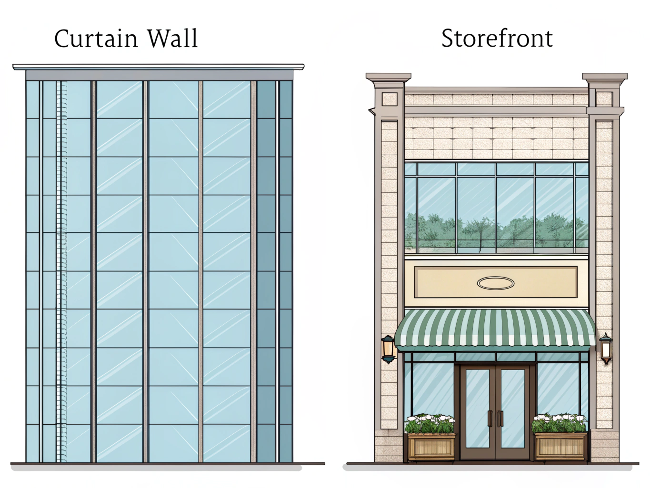
Whether you are buying domestic or asking how to import curtain wall from China, the paperwork saves you.
📝 RFQ Checklist (Storefront)
When writing your storefront system RFQ checklist, include:
- 🔹 Wind Load: Specific PSF requirements.
- 🔹 Door Hardware: “Or equal” is dangerous. Specify the brand (e.g., Dorma, Kawneer compatible).
- 🔹 Finish: AAMA 2603 (interior) vs AAMA 2605 (exterior high durability).
- 🔹 Glass: Storefront vs window wall specification mistakes often involve forgetting to specify Low-E coatings.
🔗 Internal Link: How to Import Curtain Wall from China?
🏙️ RFQ Checklist (Curtain Wall)
For curtain wall RFQ checklist, you must add:
- 🔹 System Type: Stick or Unitized?
- 🔹 Mock-up: Curtain wall mockup testing criteria.
- 🔹 Calculations: Require PE stamped calculations.
- 🔹 Shop Drawings: Curtain wall shop drawing checklist must include anchor details.
🧪 Submittals & Mockup
- 🔹 Storefront system water test procedures: AAMA 501.2 hose test is essential on-site.
- 🔹 For curtain wall: The curtain wall mockup testing criteria (PMU – Performance Mock-up Unit) is a full-scale lab test.
🏭 Supplier Evaluation
If sourcing globally, you need to know how to evaluate curtain wall suppliers.
- 🔹 Capacity: Can they handle your volume?
- 🔹 QA: Ask for their curtain wall factory quality control checklist.
- 🔹 References: Top curtain wall manufacturers in China will always provide recent US or European project references.
🔗 Internal Link: China Top 10 Curtain Wall Suppliers
Common Mistakes & Pitfalls

🚫 The “Upper Floor” Blunder
Using storefront on upper floors (common mistake). Just don’t do it. The water control isn’t there to handle the higher wind pressures and lack of overhang protection found at elevation.
📄 The Specification Gap
High quality storefront spec not enough. Simply saying “high quality” means nothing.
✅ The Fix: You must specify “Air Infiltration < 0.06 CFM” (or your specific project target).
🎨 The Color Disaster
Storefront glass color consistency issues. Mixing glass batches between the storefront (ground) and curtain wall (tower) often results in two different shades of blue.
✅ The Fix: Order glass from the same “campaign” (production run).
💧 The Leaky Joint
Curtain wall storefront transition leak detail mistakes. The interface between the two systems is where 90% of leaks occur. This usually happens because differential movement tears the sealant, or the drainage planes of the two systems are not aligned.
Decision Framework (3-Step Selection Method)

Still unsure? Use this storefront vs window wall decision framework to navigate the complexity.
📍 Step 1: Define the Height & Zone
- ❓ Is it Ground Floor? → Lean Storefront.
- ❓ Is it 30+ feet high? → Lean Curtain Wall.
- ❓ Is it a residential balcony wall? → Lean Window Wall.
⚙️ Step 2: Set Performance Targets
- ❓ Do you need acoustic performance > STC 35? → Go Curtain Wall or high-end Window Wall.
- ❓ Is the design pressure > 40 PSF? → Storefront is out.
💰 Step 3: Budget vs. Risk
Check the storefront vs window wall vs curtain wall decision matrix.
If the budget is tight ($30/sqft), can you accept the risk of exposed slab edges (Window Wall)?
If not, you must find value engineering options.
Conclusion

🎯 The Final Verdict
The battle of Storefront vs. Curtain Wall (and the contender Storefront vs Window Wall) is not about which system is “better.” It is about which system is right for your building’s height, budget, and purpose.
As we discussed in the Eagle Mall case, the right answer is often a strategic combination of both.
🏭 From the Factory Floor
At our factory, we have seen it all. We have extruded the profiles, crimped the corners, and sealed the joints. If you are ready to stop guessing and start building with confidence, send us your elevation drawings today. Let’s engineer a solution that keeps the water out and the budget in check.
🚀 Ready to get a quote?
Storefront vs Curtain Wall: FAQ
📘 Part 1: The Basics
1) What is the main difference between a storefront system and a curtain wall?
A storefront is typically an opening-based glazing system used at podium/retail/lobby levels, while a curtain wall is a full exterior façade envelope designed to span floors and handle higher structural and performance demands.
2) Which one is better for high-rise buildings?
In most cases, curtain wall. High-rise façades face higher wind pressures, more building movement, and stricter air/water performance expectations—areas where curtain wall systems are engineered to perform more reliably.
3) Can a storefront system be used above the ground floor?
Sometimes, but it depends on design pressure (wind load), water resistance requirements, movement allowances, and anchorage design. Once you push storefront to meet façade-grade performance, it often stops being cost-effective.
⚙️ Part 2: Performance & Technical
4) Which system has better air and water performance?
Typically curtain wall, especially when specified with tested targets and detailed as a drained/pressure-managed system. Storefront can perform well in its intended use case, but it’s more sensitive to installation quality and higher-pressure conditions.
7) What are the most common leak causes for each system?
- Storefront: Rushed installation, weak perimeter sealant/air barrier transitions, poor flashing/weep execution, using storefront in higher-pressure conditions.
- Curtain wall: Slab-edge tolerance issues, anchor alignment problems, poorly executed stack joints, incomplete air/water barrier continuity at transitions.
8) Which system handles building movement better?
Curtain wall. It’s designed with movement accommodation strategies (anchors, joints, receptors) to handle interstory drift and slab deflection better than typical storefront framing.
💰 Part 3: Cost & Schedule
5) Which one is cheaper: storefront or curtain wall?
Usually storefront for podium/retail/lobby applications. Curtain wall costs more due to heavier engineering, slab-edge anchorage, more complex fabrication, and stricter performance/testing expectations.
6) Which one installs faster?
Storefront is often faster at low elevations (simpler access and lighter framing). Curtain wall may be faster overall on large buildings when unitized modules and factory-prep reduce field labor—though it usually needs more time upfront for engineering and approvals.
🎯 Part 4: Decision Making
9) How do I decide which system to specify early in design?
Use this simple filter:
- 👉 If it’s podium/retail/entrance glazing in openings → Start with storefront.
- 👉 If it’s a multi-story exterior skin or has high wind/water requirements → Start with curtain wall.
Then confirm using design pressure, water rating, movement demands, and system test reports.
10) What should I ask a supplier/contractor before choosing?
Ask for: system test reports (air/water/structural), the design pressure range, water resistance targets, deflection limits, anchorage concept, movement accommodation details, and a transition/detail list (slab edge, corners, parapets, sills, entrances). This is where most risk lives.


 English
  Arabic
  German
  Spanish
  French
  Italian
  Japanese
  Korean
  Portuguese
  Russian