
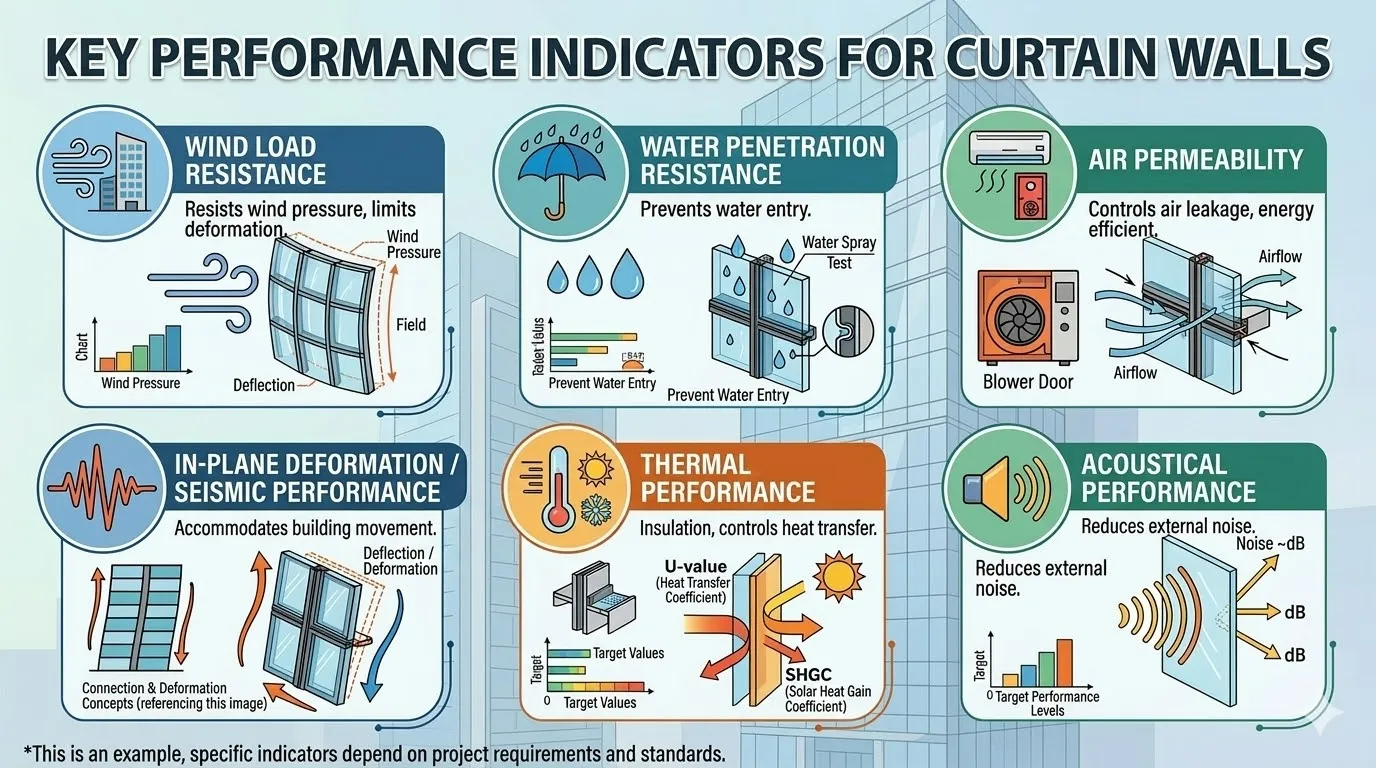

🏗️1. Introduction: Why Performance Indicators Make or Break Curtain Walls
1.1 How Metrics Tie to Codes, Procurement Specs, and Acceptance
Performance criteria are the backbone of any architectural specification. They bridge the gap between abstract design intent and tangible compliance. Without strict acceptance criteria, submittals become a guessing game, and QA/QC processes lose their teeth. A vague requirement simply stating “must withstand wind” is useless; a precise specification defines the load case, the performance target, and the test method for verification. This clarity is essential to avoid contractual disputes during the acceptance phase.
1.2 Different Systems, Different Priorities
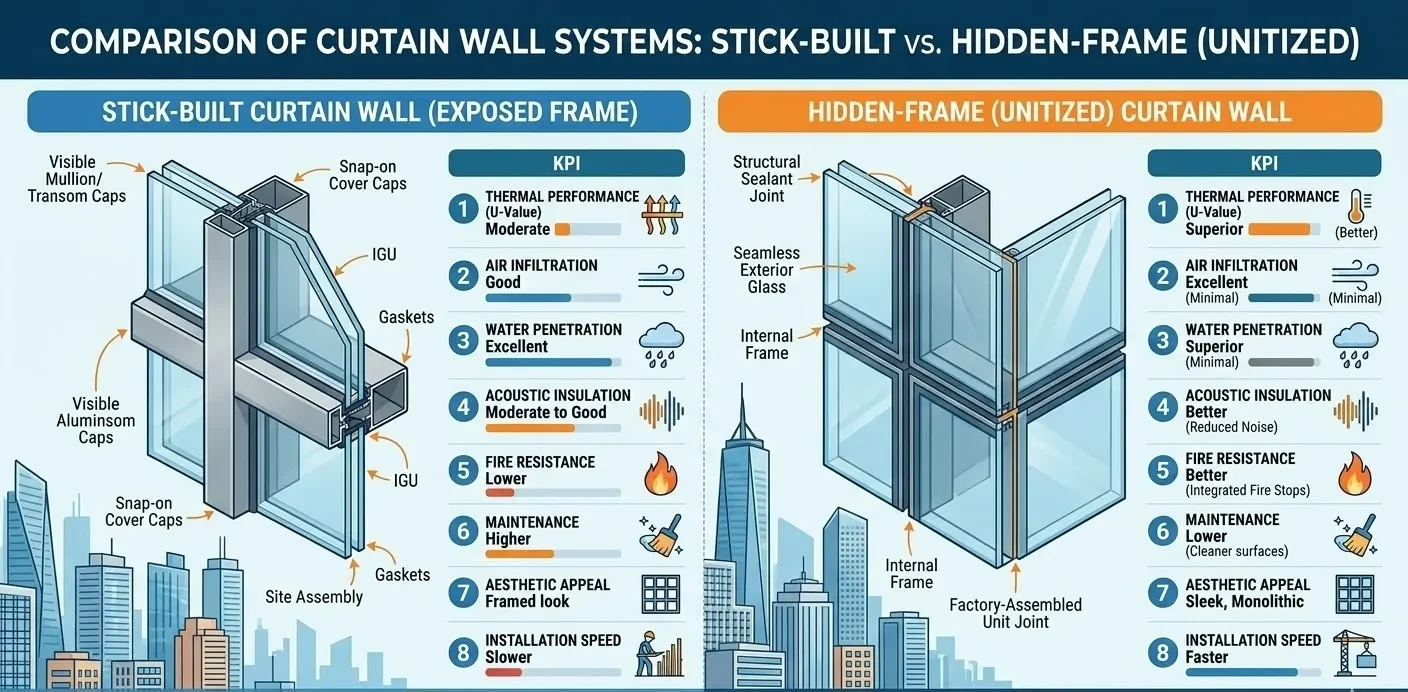
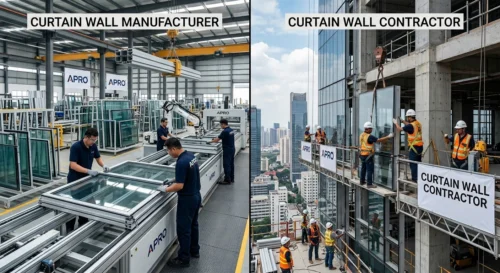
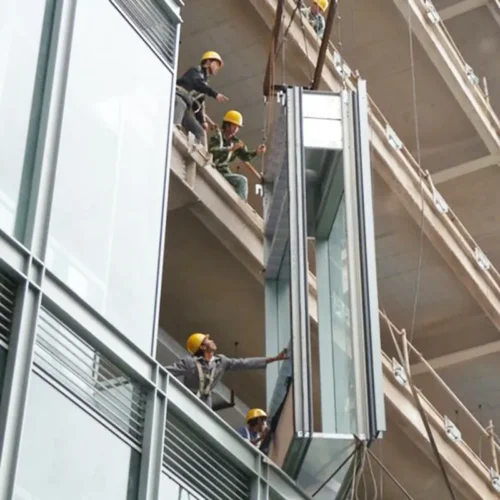
Not all systems are created equal, and their design criteria must reflect their structural realities. A stick-built curtain wall relies heavily on field installation quality, making on-site water testing critical. Conversely, a unitized curtain wall is assembled in a controlled factory environment, shifting the focus to the performance of the interlocking gaskets during interstory drift. Point-supported glazing systems require meticulous analysis of the localized stresses around the hardware. To understand the players behind these systems, refer to our guide on top .
1.3 The “3-Part Definition” of Any Metric
A robust performance indicator always consists of three elements:
- Load Case: What is the specific environmental or structural stress being applied?
- Target/Limit: What is the acceptable boundary of performance (e.g., maximum deflection)?
- Verification Method: How will we prove compliance (e.g., calculation, lab test, field test)?
🛡️2. Structural Safety & Movement Performance
2.1 Wind Load Resistance
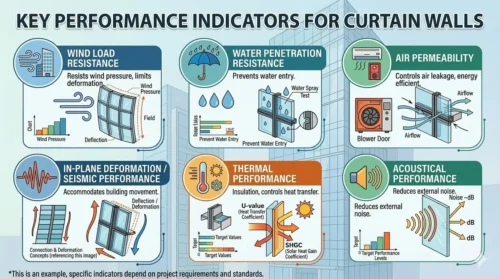
The facade must resist positive and negative wind pressures without catastrophic failure or excessive bending.
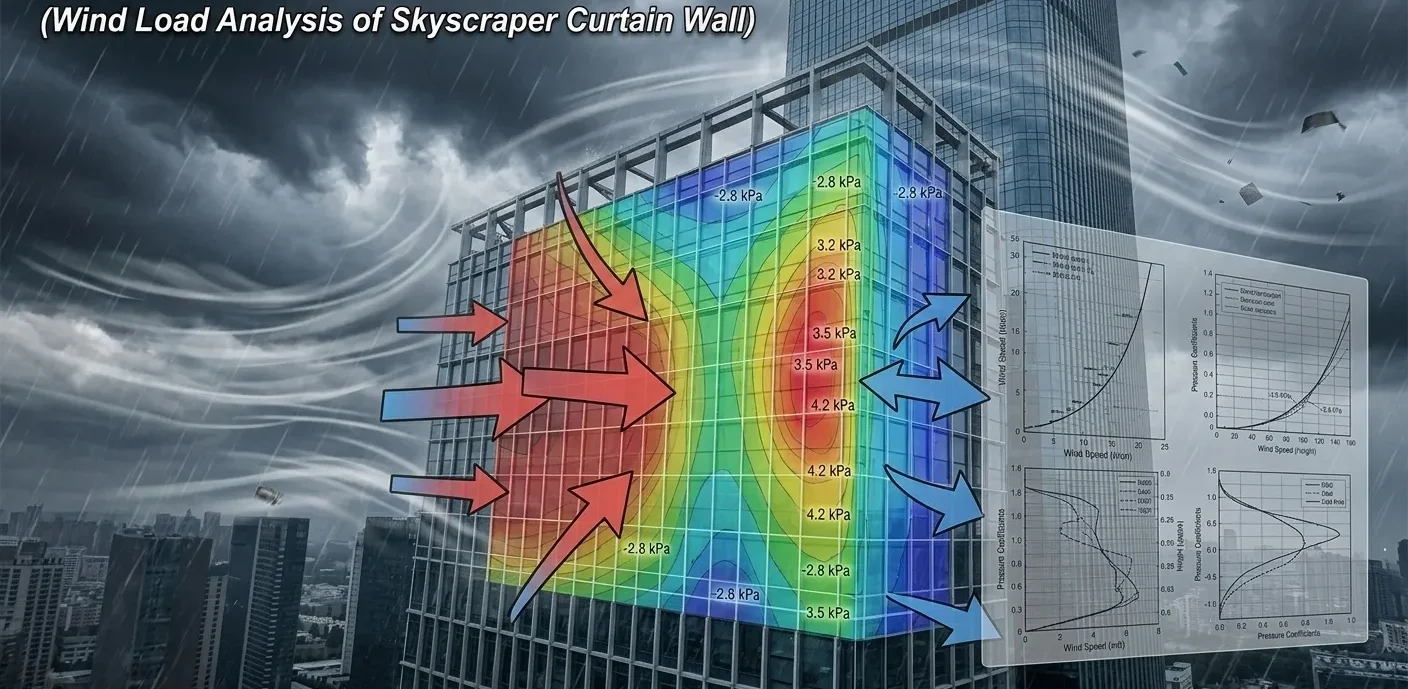
- Metric: The system must withstand the specified design pressure.
- Verification: Laboratory testing (e.g., ASTM E330) applies uniform static air pressure. We evaluate structural capacity at the ultimate limit state (to ensure safety) and deflection limits at the serviceability state (to ensure the glass doesn’t pop out or crack).
2.2 Interstory Drift Accommodation
Buildings move. Whether due to seismic activity, wind sway, or foundation settlement, the facade must accommodate interstory drift without breaking the weather seal or dropping glass.
- Metric: The system must absorb a specified story drift ratio (e.g., L/100).
- Design Strategy: This requires specialized movement joints and sufficient building tolerance built into the extrusion racking design.

2.3 Dead Load and Anchorage Capacity
The weight of the facade (dead load) must be transferred safely back to the main building structure.
- Metric: Brackets and embed plates must have sufficient shear capacity and pull-out strength.
- Verification: Rigorous structural analysis of the fasteners and bracket design, often supplemented by on-site pull-out testing of post-installed anchors.
2.4 Panel Safety
If the glass breaks, it must not become a lethal hazard.
- Strategy: Utilizing safety glazing such as laminated glass or fully tempered glass. The design must account for post-breakage behavior, ensuring sufficient retention to provide fallout protection until replacement can occur.
🏢
3. Building Envelope Performance (Air, Water, Thermal, Acoustic)
3.1 Air Infiltration / Airtightness
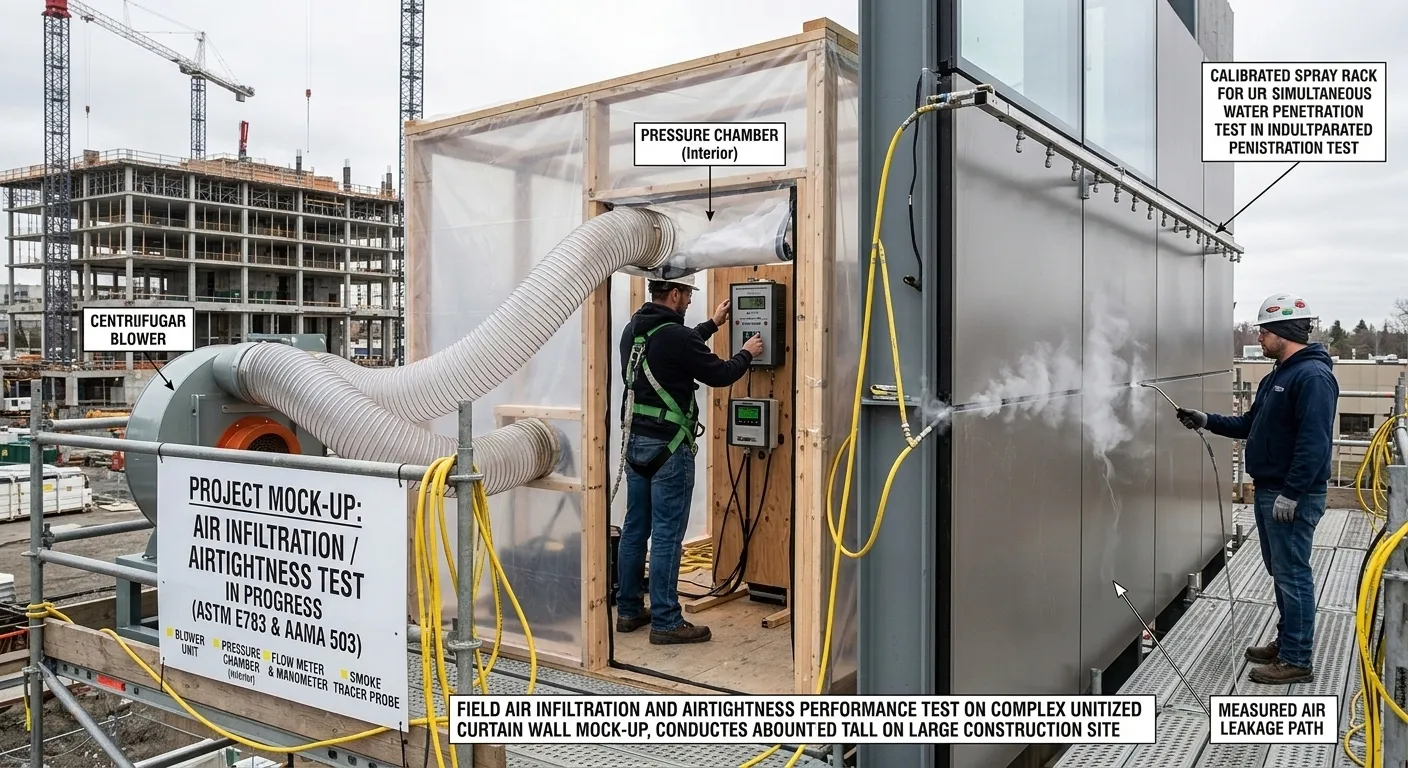
Uncontrolled air leakage leads to energy loss and drafty interiors.
- Metric: Maximum allowable air infiltration rate (e.g., L/s·m²) at a specific pressure differential.
- Verification: Lab and field testing according to standards like ASTM E283 or EN 12153 to ensure airtightness limits are met.
3.2 Water Penetration Resistance
Keeping water out is often the most challenging aspect of facade design.
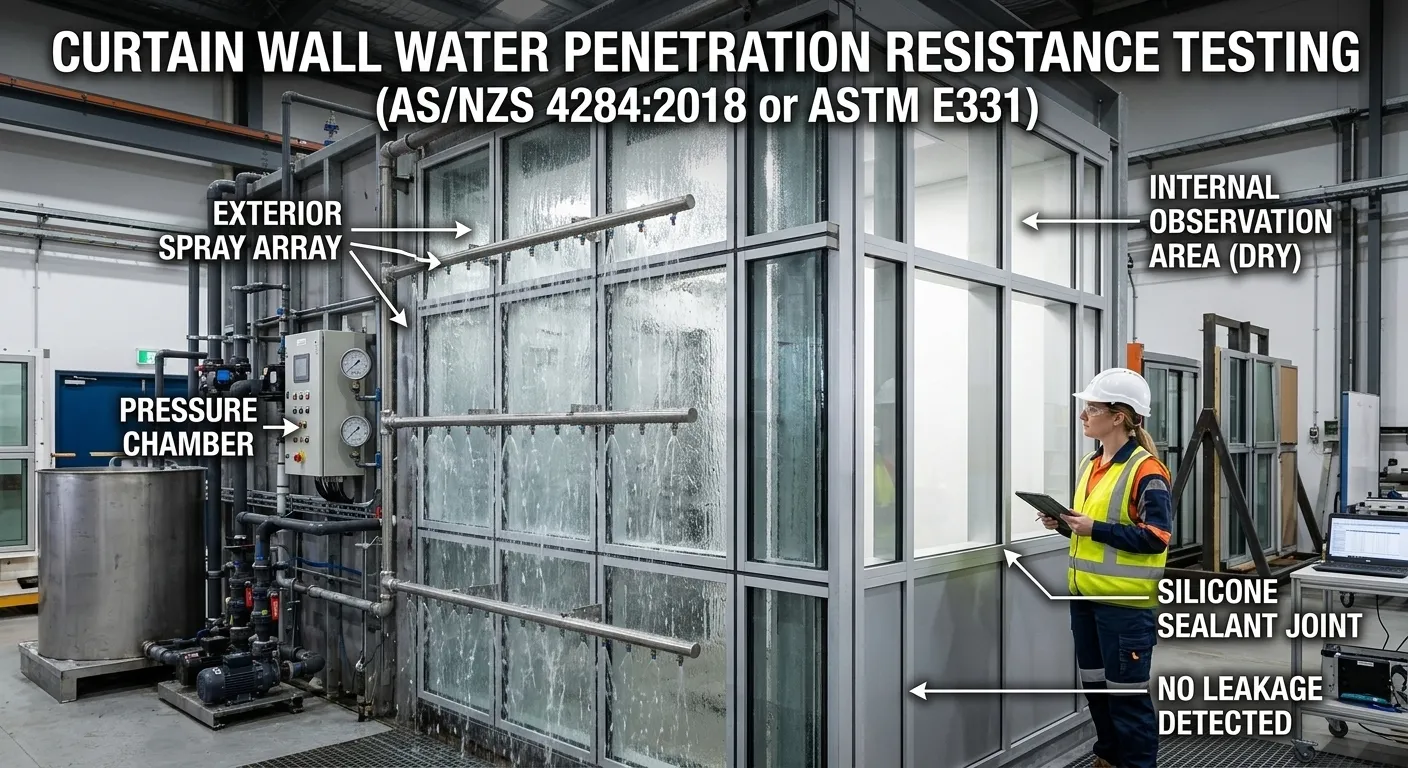
- Verification: We rely on both static water tests (ASTM E331) and dynamic water tests (AAMA 501.1), which use an aircraft engine to simulate driving rain, ensuring superior water tightness.
When evaluating water penetration, it is crucial to understand the testing framework. According to the widely adopted ASTM E331 Standard Test Method for Water Penetration of Exterior Windows, Skylights, Doors, and Curtain Walls by Uniform Static Air Pressure Difference, the test specimen is subjected to a uniform static air pressure difference while water is sprayed at a constant rate. This ensures that the system’s design, including its drainage and sealing methods, can withstand sustained wind-driven rain scenarios without leaking into the interior.
3.3 Rain-Screen Drainage & Pressure Equalization
Modern facades rarely rely on a single line of defense (barrier seal).
- Design Strategy: We employ rainscreen principles with a drained cavity. An equalization chamber behind the outer seal reduces the pressure differential that drives water inward. Any water that does enter is managed via a defined drainage path and weep holes.
3.4 Thermal Insulation & Energy Performance
The facade is a critical component of the building’s energy strategy.
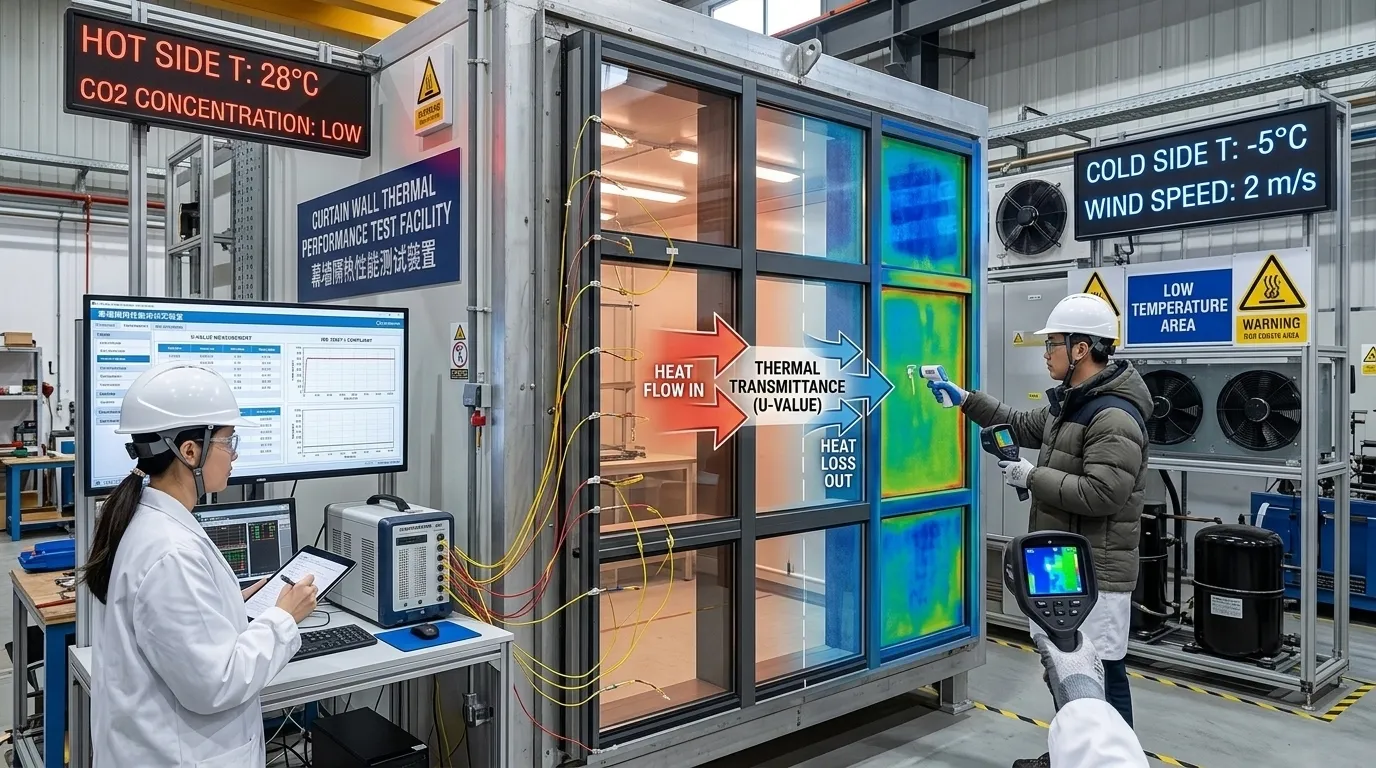
- Metrics: We measure thermal transmittance via the U-value and evaluate the Solar Heat Gain Coefficient (SHGC) to manage solar heat gain.
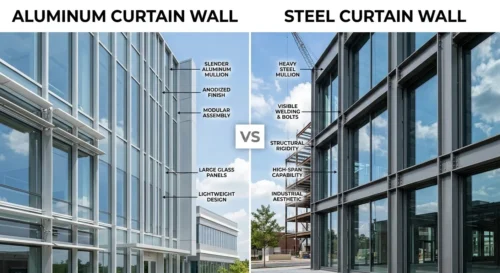
- Design Strategy: Utilizing high-performance thermal breaks within the aluminum framing to meet stringent energy code requirements.
3.5 Condensation Control
Condensation can lead to mold risk and degraded interior finishes.
- Metric: We calculate the surface temperature factor and perform a dew point analysis to mitigate the thermal bridge effect.
- Verification: Hygrothermal analysis (e.g., ISO 13788) helps ensure the interior surfaces remain above the dew point under specified winter conditions.
3.6 Acoustic Performance
In urban environments, keeping traffic noise out is essential for occupant comfort.
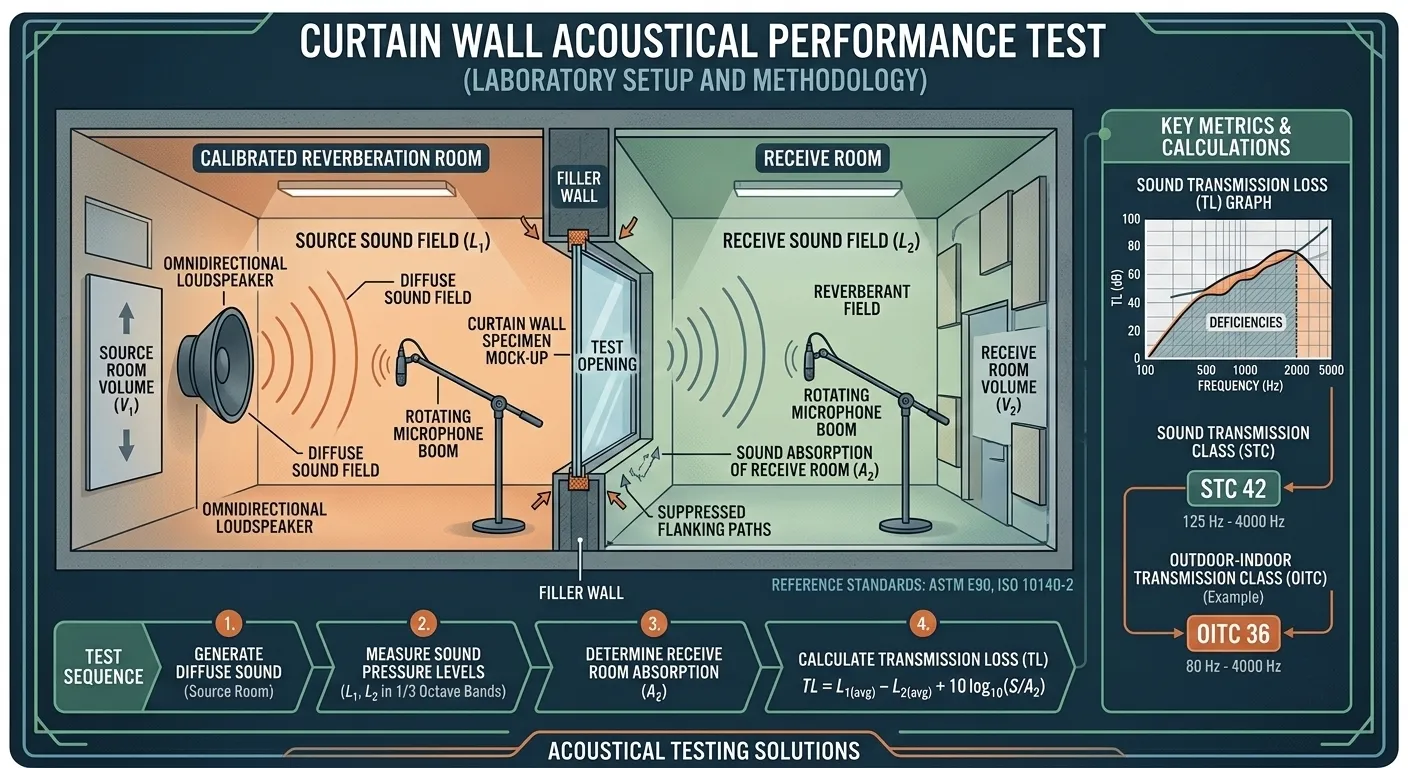
- Metrics: We use Sound Transmission Class (STC), Outdoor-Indoor Transmission Class (OITC), or the weighted sound reduction index (Rw) to quantify sound insulation.
- Design Considerations: We must address not just the glass, but flanking transmission paths through the mullions and perimeter seals to achieve true facade acoustics.
🧯4. Fire & Life Safety Performance
4.1 Perimeter Fire Barrier / Slab-Edge Firestopping
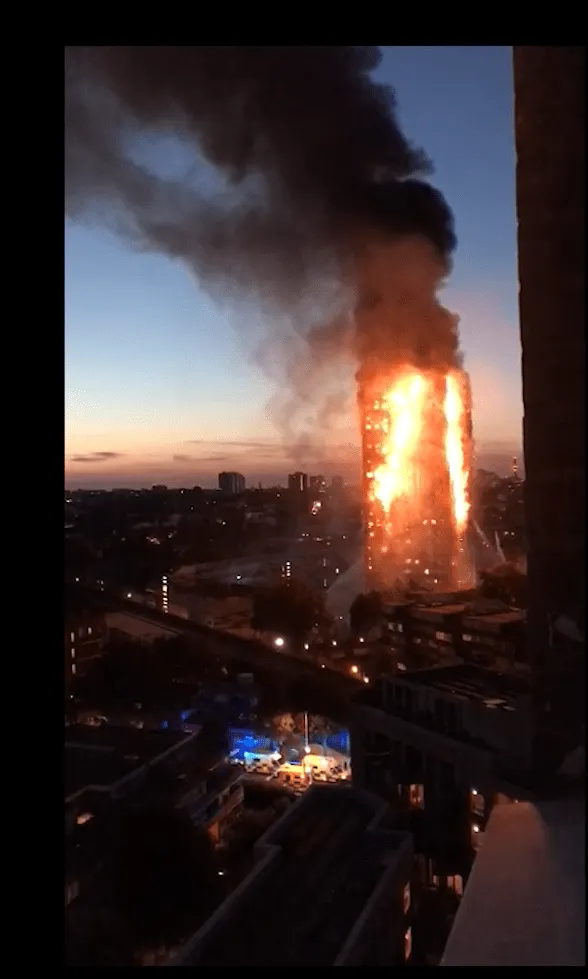
Fire must not jump between floors through the gap between the slab edge and the facade.
- Metric: The perimeter fire containment system (often mineral wool and smoke seal spray) must maintain its integrity for a specified duration (e.g., 2 hours).
- Verification: Testing to ASTM E2307 or specific UL systems for slab edge firestop.
4.2 Reaction-to-Fire Ratings for Components
The materials themselves must not contribute significantly to a fire.
- Metrics: We evaluate combustibility, flame spread, and smoke development according to standards like EN 13501-1 or ASTM E84.
- Focus Areas: The insulation core, spandrel panels, and even the weather sealants must meet strict fire classification requirements.
4.3 Fire Spread & Smoke Migration Control
The design must prevent the rapid spread of fire and smoke.
- Strategy: Effective compartmentation using cavity barriers to mitigate the chimney effect, which can draw flames rapidly up the building exterior.
4.4 Impact Resistance & Occupant Safety
The facade must protect occupants from accidental falls.
- Requirements: We design for human impact loads, utilizing safety glazing and ensuring that any integrated guardrail or opening limiter functions correctly for fall prevention.
🌦️5. Durability & Environmental Resistance
5.1 Weathering Resistance
The facade must survive decades of UV exposure.
- Metrics: We monitor weatherability, specifically the UV resistance of coatings (checking for chalking or cracking), sealant durability, and gasket aging.
5.2 Corrosion Resistance
Metals must survive their environment.
- Metrics: We perform salt spray testing (ISO 9227) to evaluate corrosion resistance, especially in marine environments.
- Strategy: Selecting the correct stainless steel grade, utilizing high-quality anodizing or powder coating, and meticulously detailing connections to prevent galvanic corrosion between dissimilar metals.
5.3 Thermal Cycling / Freeze–Thaw Performance
Extreme temperature swings can tear a facade apart.
- Strategy: We must account for thermal expansion and the risk of cold brittleness in plastics and rubbers, which can lead to seal failure and material fatigue under repeated freeze–thaw cycles.
5.4 Stain Resistance & Cleanability
A facade is only beautiful if it can be kept clean.
- Strategy: Evaluating the stain resistance of finishes and utilizing hydrophobic coatings or self-cleaning glass to minimize surface contamination and reduce the frequency of facade maintenance.
🛠️6. Functional Use & Maintainability
6.1 Operable Window Performance
If a window opens, it must do so reliably for decades.
- Metrics: We measure the operating force required and conduct a cycling test to ensure hardware durability. Crucially, we must verify air/water performance retention after thousands of cycles.
6.2 Maintainability / Replaceability
Components will eventually fail; replacing them shouldn’t require dismantling the building.
- Strategy: Designing for maintainability means ensuring easy access for replacement of glazing, gaskets, and window hardware.
6.3 Drainage Maintainability
A weep system only works if it isn’t clogged.
- Strategy: Incorporating anti-clog design features, ensuring inspection access, and implementing debris management protocols to maintain the drainage path.
6.4 Integration with Building Maintenance Systems
How will workers clean the glass?
- Integration: The facade design must coordinate with the BMU (building maintenance unit), incorporating tie-back anchors, roof restraints, and davit systems for safe façade access and fall arrest.
📏7. Aesthetics & Quality Indicators (Common Handover Disputes)
7.1 Alignment, Plumbness, Flatness
The grid must be perfect.
- Metrics: We establish strict tolerance limits for plumb, level, and flatness. Regular as-built surveys are necessary to ensure alignment of the façade grid matches the setting-out drawings. For standard dimensions to aid in this alignment, check our guide on .
7.2 Color Consistency and Glare
- Metrics: We measure color uniformity across coating batches, monitor gloss levels, and check for haze or iridescence. Glare and visual distortion must be controlled to ensure the architect’s vision is realized.
7.3 Sealant Joint Appearance
A messy joint ruins a beautiful facade.
- Metrics: We specify the exact joint width and joint depth. We inspect the tooling quality, test for adhesion, and reject joints showing bubbling or contamination.
7.4 “In-Use Defects”
These are the issues that drive occupants crazy.
- Metrics: We must perform defect diagnosis to eliminate water leakage, wind noise, rattle, vibration, and thermal popping, which are the primary sources of occupant complaints.
✅
8. Verification, Testing & Acceptance Path
8.1 Analytical Validation
Before we build, we calculate.
- Methods: We utilize structural analysis software, thermal modeling, finite element analysis (FEA), drift analysis, and hygrothermal analysis to predict performance.
8.2 Laboratory Performance Testing
We prove the calculations on a performance mock-up.
- Methods: We conduct rigorous laboratory testing to standards like ASTM E330, ASTM E331, AAMA 501, and EN 13830 to validate the design before mass production.
8.3 Manufacturing QA
Quality is built on the factory floor.
- Methods: We rely on factory QA, first article inspection, process control, and comprehensive traceability using batch records to manage any NCR and ensure a successful FAT.
8.4 Field Testing
The final check on site.
- Methods: We conduct a field water test (hose test per ASTM E1105), field air leakage testing, and use infrared thermography to identify any installation flaws before resolving the final punch list.
🏙️9. Metric Prioritization by Building Type
9.1 Supertall/High-Rise Focus
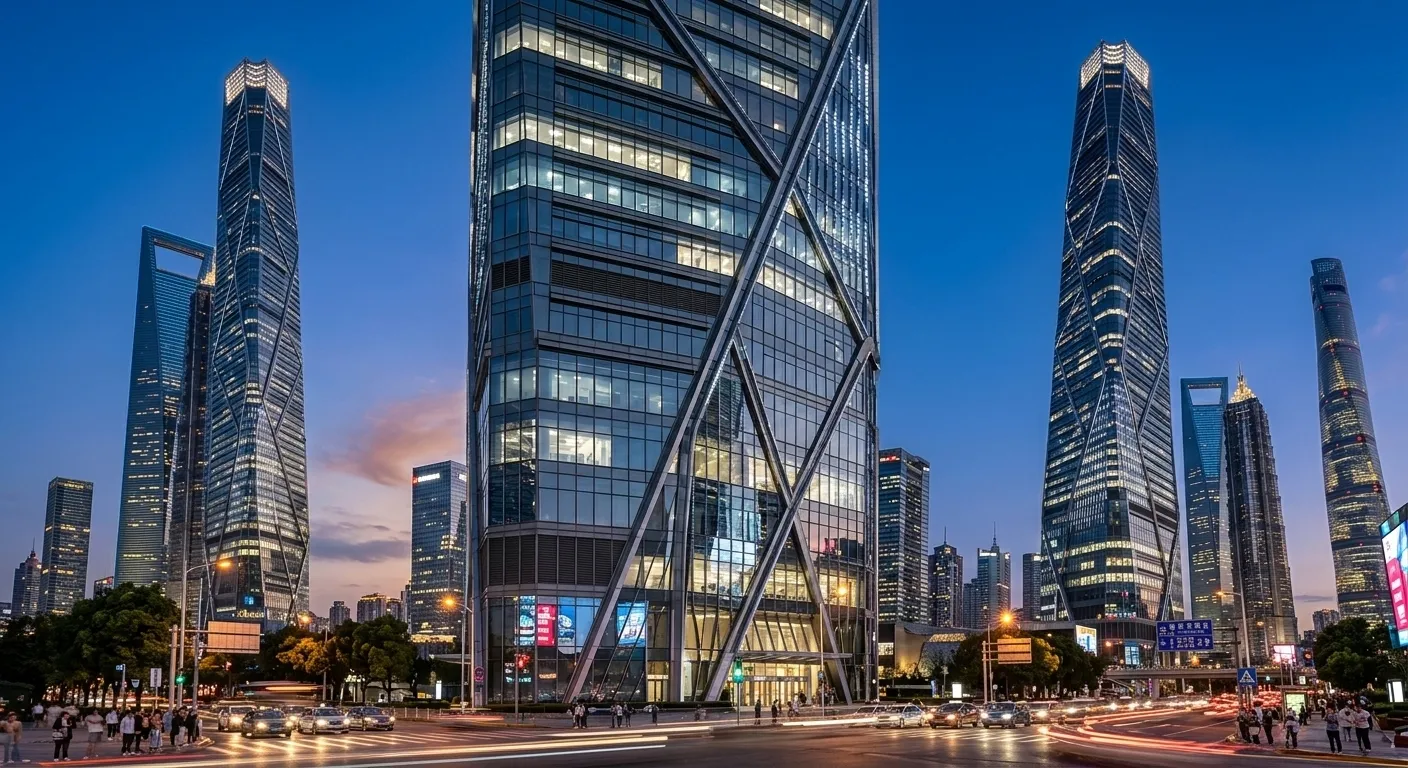
Priorities: High-rise façade engineering focuses intensely on wind engineering, accommodating massive drift, managing the stack effect, and ensuring seamless BMU coordination and structural redundancy.
9.2 Healthcare / Education Focus

Priorities: These environments demand acoustic privacy, stringent thermal comfort, hygiene, safety (including strict operable limitation), and high indoor air quality (IAQ).
9.3 Retail / Mixed-Use Focus

Priorities: The focus shifts to robust smoke control, fire compartmentation, dynamic water penetration resistance at complex geometries, entrance performance, and long-term durability under traffic.
9.4 Coastal / Cold Climate Focus
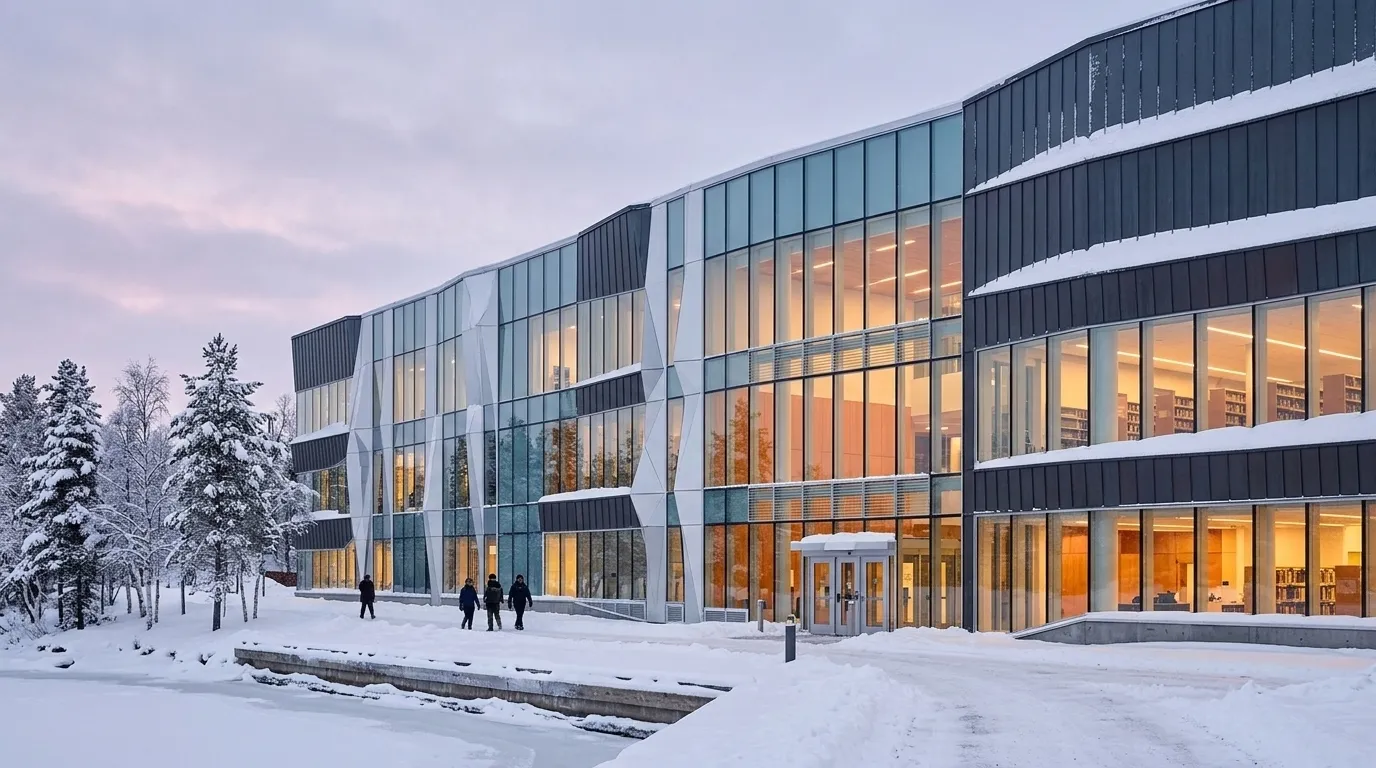
Priorities: We must prioritize protection against marine exposure and salt corrosion, while implementing strict condensation control, cold climate detailing, and mitigating thermal bridging to survive aggressive freeze–thaw cycles.
📝10. Conclusion: Turning Metrics into Executable Spec Language
10.1 A Practical Spec-Writing Template
A true performance specification leaves no room for ambiguity. Use this compliance matrix template:
[Metric/Attribute] shall meet a [Performance Target] under [Specific Load Case/Condition], as verified by [Specific Test Method].
Example: Water penetration resistance (Metric) shall allow zero leakage (Target) at a static pressure differential of 15 psf (Condition), as tested in accordance with ASTM E331 (Method).
10.2 Common Mistakes
Avoid vague specs like “must meet code.” These lead to scope gaps and ambiguous requirements. If you fail to define the test conditions, you open the door to endless contractual disputes.
A well-written spec is the first, and most important, step in delivering a high-performance facade.


 English
  Arabic
  German
  Spanish
  French
  Italian
  Japanese
  Korean
  Portuguese
  Russian