


🏙️ Introduction: Defining the City Skyline
When you look at the skyline of a modern city, what defines its character?
It is the skin of the curtain wall facade.
For developers and architects, selecting the appropriate curtain wall system is not just about aesthetics; it is about performance, budget, and longevity.
However, navigating the complex world of curtain wall architecture can be daunting. From visible frames to seamless glass skins, each option carries different implications for your project’s timeline and bottom line.
In this guide, we will break down the 5 essential types of curtain wall system designs dominating the market in 2025, offering you direct factory insights that you won’t find in a textbook.
🏗️ Why is selecting the right curtain wall type crucial for your building?
Choosing the correct curtain wall system is the single most critical decision impacting a building’s thermal performance, weather resistance, and visual identity.
A mismatched system can lead to skyrocketing energy bills, water leakage nightmares, and budget overruns during the curtain wall construction phase.
Whether you are prioritizing rapid installation for a high-rise or maximum transparency for a showroom, understanding the specific “DNA” of each system is the first step to a successful project.
🖼️ 1. What is a Visible Curtain Wall?
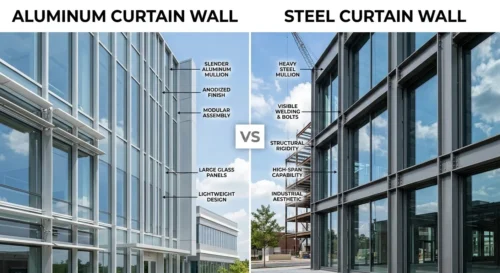
A Visible Curtain Wall, often called a “capped” system, is a traditional stick-built facade where the aluminum framing members (mullions and transoms) are visible on the building’s exterior, typically covered by decorative pressure plates and caps.

How Visible Frame Systems Work
In terms of curtain wall detail, this system relies on a mechanical clamping method. The glass is held against the internal structural gasket. A pressure plate is then screwed into the mullion from the outside, clamping the glass firmly in place. Finally, a decorative “snap-on” cover cap is installed to hide the screws and pressure plate.
Load Path: Wind loads are transferred from the glass → pressure plate → mullion → building structure.
Where Visible Frame Curtain Walls Work Best
This classic curtain wall design remains a favorite for:
- University Campuses & Government Buildings: Where a structured, rhythmic aesthetic is desired.
- Mid-rise Office Buildings: Where the budget is a primary concern.
- Projects requiring horizontal/vertical emphasis: The caps can be customized (e.g., bullnose, deep fins) to create strong architectural lines.
Key Advantages & Limitations
✅ Advantages:
- Cost-Friendly: generally cheaper than unitized or hidden frame systems.
- Mature Technology: Most installation teams are highly experienced with it.
- Easy Maintenance: Individual glass panes can be replaced easily by unscrewing the external cap.
⚠️ Limitations:
- Aesthetics: You cannot achieve that smooth, all-glass look; the grid is always visible.
- Weight: The external caps add slight dead load compared to silicone-glazed systems.
🏭 Factory Insight:
“On a recent 15-story office project in Southeast Asia, the developer initially wanted a hidden frame look. However, after we analyzed their maintenance budget, we recommended a Visible Frame system with slim profile caps. It saved them 15% upfront and made future glass replacement much simpler for their local maintenance team.”
[Check out our Visible Curtain Wall Product Series for cap customization options.]
💎 2. What is a Hidden Frame Curtain Wall?
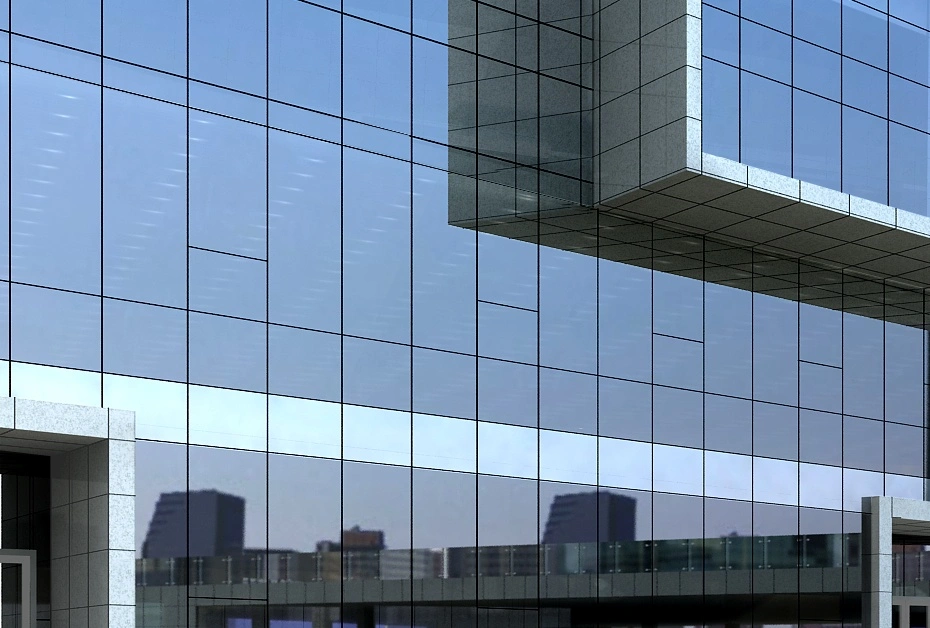
A Hidden Frame Curtain Wall (or Structural Glazing) is a system where the metal frame is concealed behind the glass, creating a continuous, seamless glass curtain wall surface bonded by high-strength structural silicone.
How Hidden Frame Systems Achieve a Seamless Glass Skin
The magic lies in the chemistry. Instead of mechanical clamps, we use structural silicone sealants to bond the glass to the aluminum frame. The exterior sees only glass and narrow silicone joints (usually 15-20mm).
The dead load of the glass is often supported by a hidden “toggle” system or setting blocks, while the silicone handles the wind load.
Advantages & Disadvantages
✅ Advantages (Pros):
- Aesthetics: Creates a sleek, monolithic “mirror” effect that modern architects love.
- Self-Cleaning: Without external caps to trap dust and water, the facade stays cleaner.
⚠️ Disadvantages (Cons):
- Maintenance: Replacing a broken pane is complex and often requires cutting through structural silicone on-site.
- Dependency: The safety of the system relies heavily on the quality of the silicone application and the curtain wall detail design.
🏭 Factory Insight: Our Checklist for Structural Glazing
When we manufacture hidden frame units, we don’t take risks. We check:
- Silicone Adhesion Test: Every batch of glue is tested against the specific glass and aluminum coating used.
- Environment: Glazing must be done in a dust-free, temperature-controlled factory environment, not on a dirty job site.
🕷️ 3. What is a Spider Curtain Wall?
A Spider Curtain Wall is a point-supported glazing system where large panes of glass are fixed by stainless steel “spider” fittings, eliminating the need for bulky aluminum frames and offering maximum transparency.

How Spider Curtain Wall Systems Carry Loads
The stainless steel arms (spiders) act as the bridge. They bolt into the corners of the glass (countersunk or exterior bolts) and transfer the load back to a structural support system. This support can be:
- A steel column or truss.
- A tension cable system (for extreme lightness).
- Glass Fins: Vertical strips of thick glass that act as structural columns.
Best Applications for Spider Glass Facades
- Flagship Retail Stores & Showrooms: Like the Apple Store aesthetic.
- Airport Terminal Entrances: For grand, welcoming views.
- Shopping Mall Atriums: To let in maximum daylight without visual obstruction.
Design Note: Transparency vs. Structure
The goal of spider curtain wall architecture is dematerialization—making the structure disappear. However, the supporting structure (like steel trusses) can be heavy. Using glass fins or tension cables offers the highest transparency but increases the engineering cost significantly.
🏭 Factory Insight: Common Mistakes We See
“Many designers underestimate the glass thickness required for spider systems. Since the glass is only held at points (not continuous edges), the stress concentration is high. We often have to upgrade specifications to thick, laminated tempered glass to ensure safety.”
☀ 4. What is a Facade Louver System?
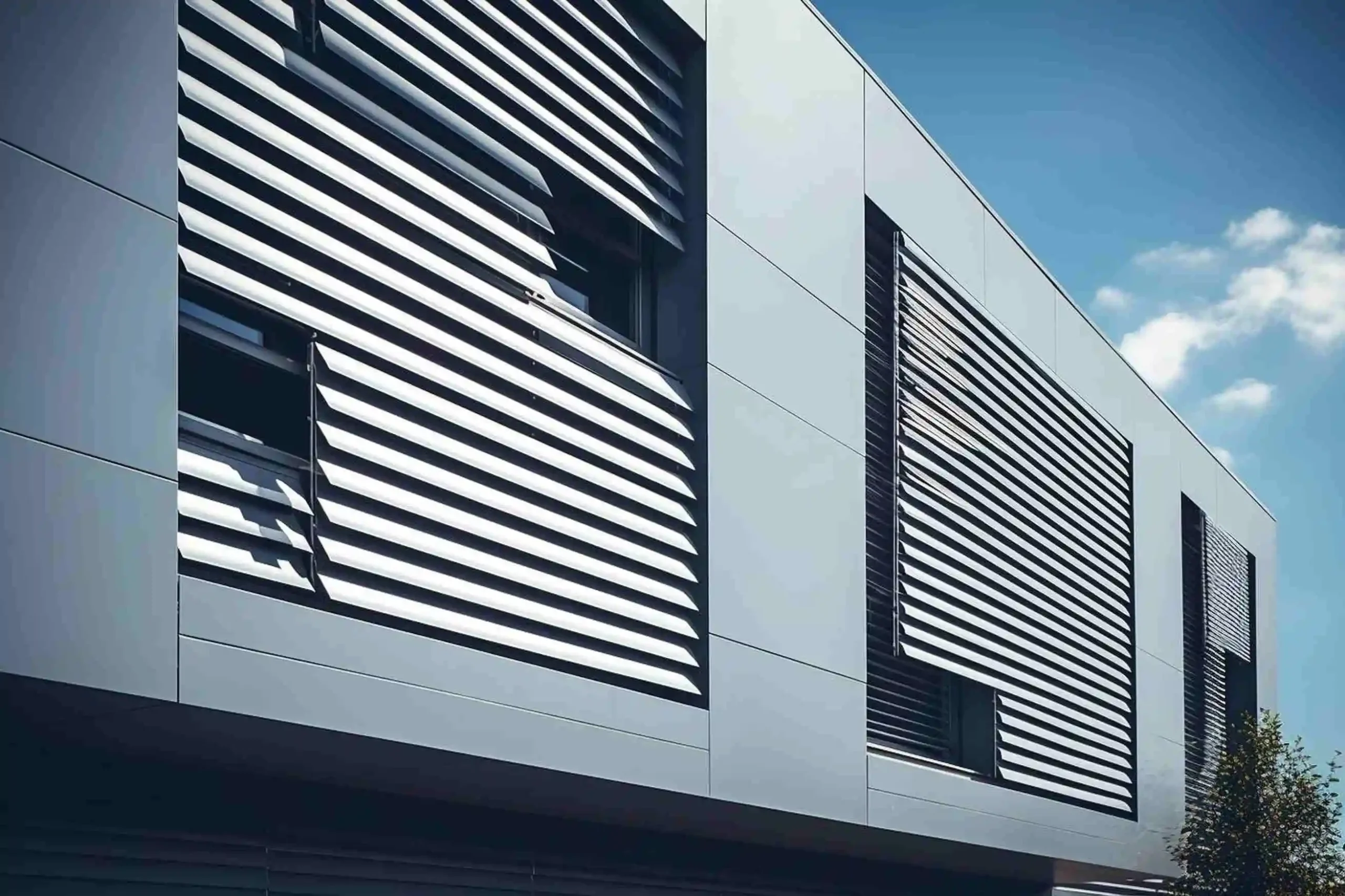
While strictly an integrated accessory, the Facade Louver system has evolved into a distinct curtain wall type where sun-shading devices (blades/fins) are anchored directly onto the curtain wall mullions to control light and heat.
How Facade Louvers Improve Energy Performance
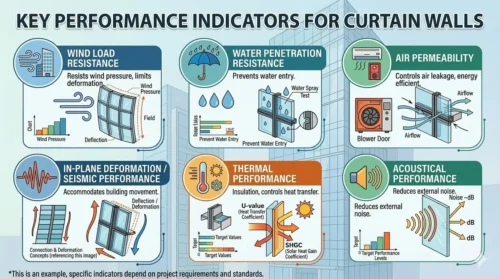
By blocking direct solar radiation before it hits the glass, louvers significantly reduce the building’s solar heat gain coefficient (SHGC). This lowers the load on air conditioning systems, making it a staple in Green Building (LEED/BREEAM) designs.
🎨 Design Options
- Aerofoil Blades: Wing-shaped aluminum profiles for a sleek, high-tech look.
- Glass Louvers: Fritted glass blades that shade while allowing some light through.
- Fixed vs. Operable: Some advanced systems allow blades to track the sun angle automatically.
📍 Best Use Cases
- West-Facing Facades: To block harsh afternoon sun.
- Tropical/Subtropical Climates: Where cooling is the primary energy cost.
- Grade A Office Towers: Combining energy efficiency with a unique visual texture.
📈 Market Insight:
With stricter energy codes in 2025, we are seeing a 40% increase in inquiries for “Integrated Shading” curtain wall systems, especially for government projects aiming for Net-Zero targets.
🏢 5. What is a Unitized Curtain Wall?
The Unitized Curtain Wall is the king of high-rise construction. It consists of large, factory-assembled panels (usually one floor high) that are shipped to the site and hung onto the building structure like puzzle pieces.

How Unitized Panels Are Fabricated and Installed
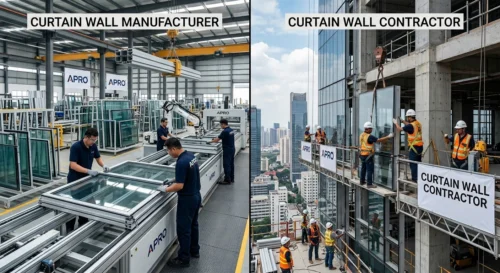
The entire process—cutting aluminum, assembling frames, installing glass, and applying seals—happens in our factory.
- Fabrication: High precision in a controlled environment.
- Transport: Panels are packed in steel stillages.
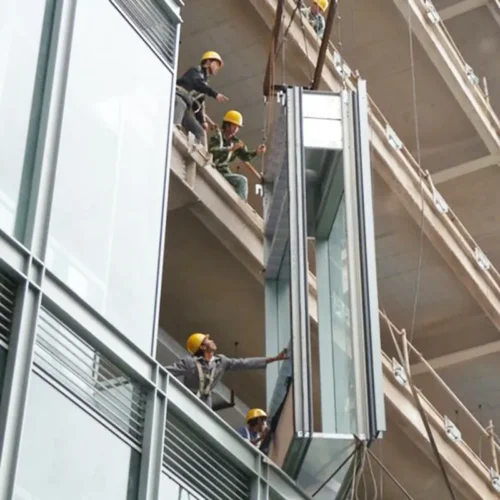
- Installation: On-site, cranes lift the panels, and they “hook” onto pre-installed anchors on the floor slabs. The panels interlock with each other using a male-female joint system.
Advantages vs. Stick-Built Curtain Walls
- Speed: Installation is 30-50% faster than stick systems.
- Quality: Factory glazing ensures perfect sealant application, reducing leak risks.
- Site Management: Requires fewer workers on-site and no external scaffolding.
🏭 Factory Insight: Why Most of Our Export Facades Are Unitized
For many of our export façade projects, unitized curtain walls are our first recommendation, especially when the building sits in an extreme climate and has a complex façade geometry.
Our NUVO Event Centre in Toronto, Ontario, Canada, is a prime example. The client wanted a high-end, modern curtain wall for the NUVO Event Centre’s facade, capable of withstanding harsh winters and hot, humid summers.We designed and supplied a custom unitized curtain wall system: each unit was precisely prefabricated and performance-tested in our factory, then shipped and installed on-site as modular panels.
Compared to a stick-built approach, this allowed us to maintain tight control over alignment and air and water tightness on the complex façade, while significantly reducing on-site safety and schedule risks and helping the owner complete the building envelope on time.
📊 How Do These Five Curtain Wall Systems Compare?
To help you decide, here is a snapshot comparison of the systems we discussed.
| Feature | Visible (Stick) | Hidden (Stick) | Spider (Point) | Unitized | Louver Integrated |
|---|---|---|---|---|---|
| Ideal Project | Low/Mid-rise Office | High-end Boutique | Lobbies/Atriums | Skyscrapers | Green Buildings |
| Install Method | Assembled on-site | Assembled on-site | Bolt fix on-site | Crane lift (Factory built) | Add-on fix |
| Transparency | Low (Grid visible) | High (Seamless) | Ultra-High | Medium | Medium (Shaded) |
| Relative Cost | $ | $$ | $$$$ | $$$ | $$$+ |
| Waterproof | Good (Dependent on worker) | Good | Moderate | Excellent (Factory sealed) | Excellent |
| Speed | Slow | Slow | Slow | Fastest | Moderate |
🛠️ How to Use This Comparison in Real Projects
A table gives you data, but applying it requires context. Based on our experience supplying hundreds of curtain wall construction projects globally, here is how we recommend matching systems to specific scenarios.
Scenario 1: The Office Tower (20–40 Floors)
Recommendation: Unitized Curtain Wall (+ Optional Integrated Louvers).
Why: Once a building exceeds 20 floors, using external scaffolding becomes prohibitively expensive and dangerous. Unitized systems allow you to close the building envelope floor-by-floor from the inside. This speed creates a faster ROI (Return on Investment) for developers who need to lease the space quickly.
Scenario 2: Hospital / University / Public Buildings
Recommendation: Visible Frame (Stick System) with selective Hidden Frame areas.
Why: Public projects often have strict budgets and long-term maintenance protocols. A Visible Frame system is robust, cheaper to repair (if a glass pane breaks), and offers excellent weatherproofing reliability without the high premium of unitized systems.
Scenario 3: Landmark Entrance or Showroom
Recommendation: Spider System (Ground floor) + Hidden Frame (Upper levels).
Why: Retail is about grabbing attention. A Spider system at eye level dissolves the barrier between the street and the product. Above the podium level, switching to a Hidden Frame system maintains the sleek look while keeping costs lower than using spider fittings for the whole building.
Scenario 4: Hot Climate / Strict Energy Codes
Recommendation: Unitized System + Facade Louvers + High-Performance Low-E Glass.
Why: In regions with intense sun or strict “Green Building” standards (like LEED Platinum), glass alone isn’t enough. Integrating aerofoil louvers directly into the unitized frame reduces cooling loads significantly without sacrificing the views.
⚠️ Common Mistakes When Choosing Curtain Wall Systems
Selecting a curtain wall type isn’t just about picking what looks good in a rendering. Here are the costly mistakes we see developers and architects make—and how to avoid them.
1. Choosing Only by Unit Price, Ignoring Lifecycle Cost
It is tempting to pick the cheapest Stick System to save upfront. However, if that system requires expensive scaffolding for 6 months longer than a Unitized system, your “savings” disappear in labor costs and delayed rental income. Always look at the installed cost, not just the material cost.
2. Copying a Reference Project from a Different Climate
We often hear, “I want the facade to look like this building in Berlin.” But if you are building in Singapore (tropical), that European design might trap humidity and heat, causing massive condensation issues. Your curtain wall detail must be adapted to your local climate load.
3. Underestimating Maintenance & Access
A seamless Hidden Frame tower looks stunning, but how will you clean it? If you haven’t planned for a Building Maintenance Unit (BMU) or gondola system, that shining glass will look dirty within a year. Visible frames are generally more forgiving and easier to access for seal repairs.
4. Not Involving a Curtain Wall Manufacturer Early
Waiting until the structural concrete is poured to finalize your facade system is a recipe for disaster. Embeds (anchors) need to be cast into the concrete before the curtain wall design is finalized. Early involvement prevents clashing and expensive retrofitting.
🤝 Work with APRO Early to Lock the Right System
There is no “perfect” curtain wall system—only the one that perfectly fits your project’s height, budget, and climate.
The safety, energy efficiency, and construction speed of your building depend on making this choice correctly during the design phase. Don’t leave it to guesswork.
🚀 Ready to optimize your facade?
Send your initial drawings or project requirements to the APRO engineering team. We will provide a system recommendation and a preliminary budget analysis to ensure your vision becomes a reality without construction headaches.
Ready to source? Check out our guide on How to Choose a High-Quality Curtain Wall Manufacturer to start vetting suppliers.


 English
  Arabic
  German
  Spanish
  French
  Italian
  Japanese
  Korean
  Portuguese
  Russian