

🏢 Curtain Wall vs Window Wall: The GC & Developer’s Guide
1. The Largest Line Item & Liability
For a General Contractor (GC) or Developer, the building envelope is often the single largest line item after the structure itself. It is also the source of the most significant long-term liability. When planning a mid-to-high-rise project, the debate often centers on two distinct systems: curtain wall vs window wall.
2. Identical Looks, Profound Risks
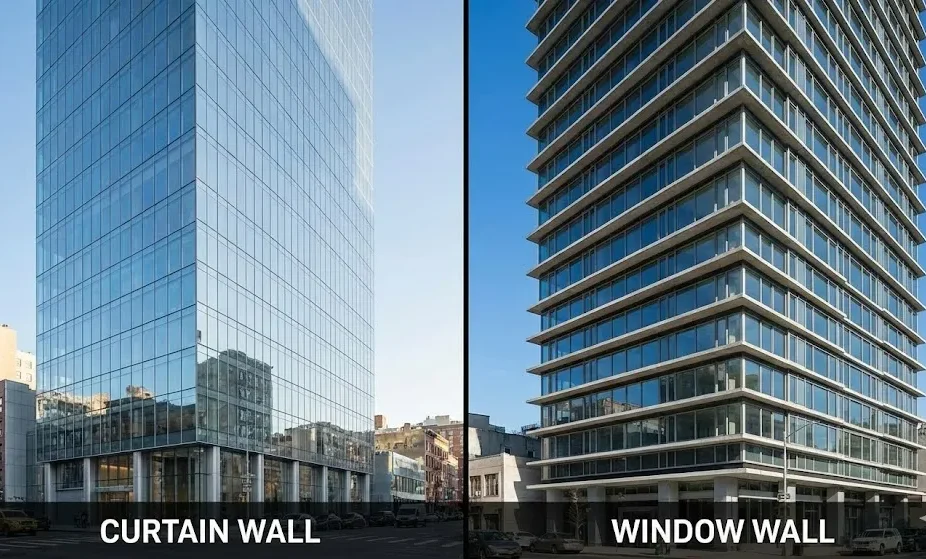
While they may look identical from the street—glass and aluminum wrapping a building—the difference in how they handle water, structure, and risk is profound. Choosing the wrong system can lead to:
- ⚠️Leakage: Window wall leakage at slab edges (a common problem).
- ⚠️Budget: Blown budgets due to hidden firestopping costs.
- ⚠️Schedule: Nightmares when crane time runs out.
3. What You Will Learn
In this guide, based on our over ten years of global manufacturing and multi-country project experience, we will introduce the differences between the two systems. We will provide:
- A comparison table of curtain walls and window walls.
- A deep dive into the curtain wall liability matrix.
This helps you make the right engineering and financial decisions for your next project.
You may want to revisit the fundamentals in our guide:What is a Curtain Wall? to understand the baseline technology.
🏗️ What is a Curtain Wall System?
A curtain wall is a non-structural building envelope that hangs outside the floor slabs, acting like a continuous “curtain.” Because it bypasses the slab, it creates a continuous air and water barrier, making it the preferred solution for high-performance and high-rise structures.

1. How it Works: Continuous Protection
The curtain wall transfers wind loads and dead loads back to the primary structure, usually at the floor line. Key features include:
- 💧Pressure-Equalized Drainage: A sophisticated strategy using pressure-equalized curtain wall drainage strategy explanation to manage water ingress.
- 🛡️Continuous Insulation: Because the system runs past the slab, it allows for a continuous air barrier curtain wall system, minimizing thermal bridging.
2. The Pros
- ✅ Unlimited Capability: Curtain wall vs window wall for high-rise buildings capability is unmatched.
- ✅ Performance: Superior water/air tightness.
- ✅ Aesthetics: Aesthetic continuity (all-glass look).
3. The Cons
- ⚠️ Cost: Higher material and logistics costs.
- ⚠️ Access: Requires exterior crane/hoist access.
- ⚠️ Maintenance: Curtain wall maintenance from exterior requires BMU (Building Maintenance Unit).
4. Best Use Cases
- 🏢Grade-A Office Towers.
- 🏨Luxury Hotels requiring high acoustic performance (OITC/STC).
- 🏗️Complex Structures: Buildings with complex geometries or heights exceeding 20-30 stories.
For a deeper look at specific types, check our guide on:
5 Types of Curtain Wall Systems
🪟 What is a Window Wall System?
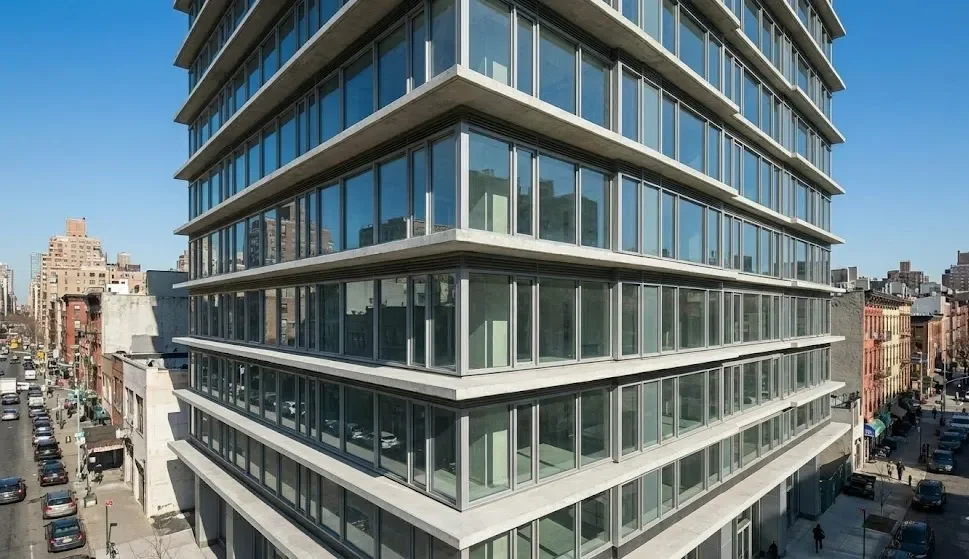
A window wall is a glass facade system installed between floor slabs (slab-to-slab): it typically rests on the edge of the lower floor slab and is fixed to the upper floor slab, forming the exterior wall through the assembly of repeating window units.
1. Window Wall System Definition
The window wall system definition describes a glazing system that sits between the floor slabs, resting on the slab edge below and anchored to the slab above. Unlike curtain walls, it does not hang continuously; it is compartmentalized by floor.
2. How it Works: Compartmentalization
Window wall acts like a large, factory-glazed window installed between concrete decks.
- 🧱Slab Edge Exposure: The slab edge itself must be covered separately (usually by a metal slab cover) and sealed.
- 🚧Split Responsibility: The glazing contractor handles the glass; the waterproofing/firestopping contractor often handles the slab edge interface.
3. The Pros
- ✅ Cost: Significantly lower curtain wall vs window wall cost.
- ✅ Installation: Installs from the inside (safer, less weather dependent).
- ✅ Integration: Allows for easy integration of balconies.
4. The Cons
- ⚠️ Risk: Window wall slab edge detail risk points are high (leakage).
- ⚠️ Aesthetics: Look is broken by slab covers.
- ⚠️ Acoustics: Lower acoustic isolation between floors.
- ⚠️ Head Detail: Window wall head detail at slab edge leakage risk.
5. Best Use Cases
- 🏢Mid-to-High Rise Residential (Multifamily).
- 🏗️Projects with extensive balconies.
📊 Curtain Wall vs Window Wall: The 12-Point Comparison Matrix
To help GCs visualize the trade-offs, here is the ultimate curtain wall vs window wall comparison table.
| Feature | Curtain Wall | Window Wall |
|---|---|---|
| Structure Relation | Hangs in front of slab (Bypass) | Sits between slabs (Infill) |
| Aesthetics | Continuous, seamless glass skin | Broken by slab edge covers |
| Best For | Office Towers, Luxury High-Rise | Multifamily Residential, Balconies |
| Water/Air Tightness | Superior (Continuous barrier) | Good (Dependent on slab edge seal) |
| Thermal Efficiency | High (Thermal break continuity) | Moderate (Slab edge is a thermal bridge) |
| Acoustics | High vertical isolation | Risk of window wall lateral sound transmission |
| Installation | Exterior (Crane/Monorail) | Interior (Floor-by-floor) |
| Schedule | Independent of concrete cycle | Tied to concrete pouring/curing |
| Cost Profile | Premium ($$$) | Budget-Friendly ($$) |
| Maintenance | Exterior access (BMU/Swing stage) | Some interior access possible |
| Responsibility | Single Source Responsibility | Fragmented (Glazing vs. Slab Cover) |
| Max Height | Unlimited (Structural) | Limited by deflection/engineering |
📐 The Real Technical Difference: Slab Edge Details
1. Where the Battle is Won or Lost
This is where the battle is won or lost. As a GC, if you ignore the difference between curtain wall and window wall slab edge details, you are inviting future leakage claims.
2. Curtain Wall: The Bypass Strategy
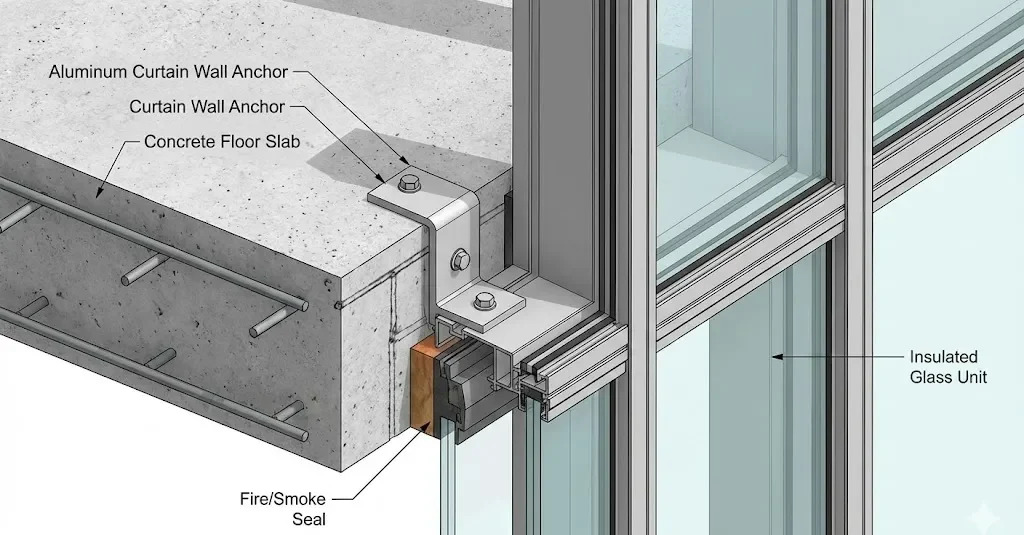
In a curtain wall slab edge bypass detail, the aluminum frame runs continuously past the concrete.
- 🛡️Water Line: The gap is filled with firestopping, but the water line is inches away, outside the building.
- 🌡️Efficiency: This continuous insulation capability makes it superior for curtain wall vs window wall energy efficiency thermal bridge management.
3. Window Wall: The Stop & Start Risk
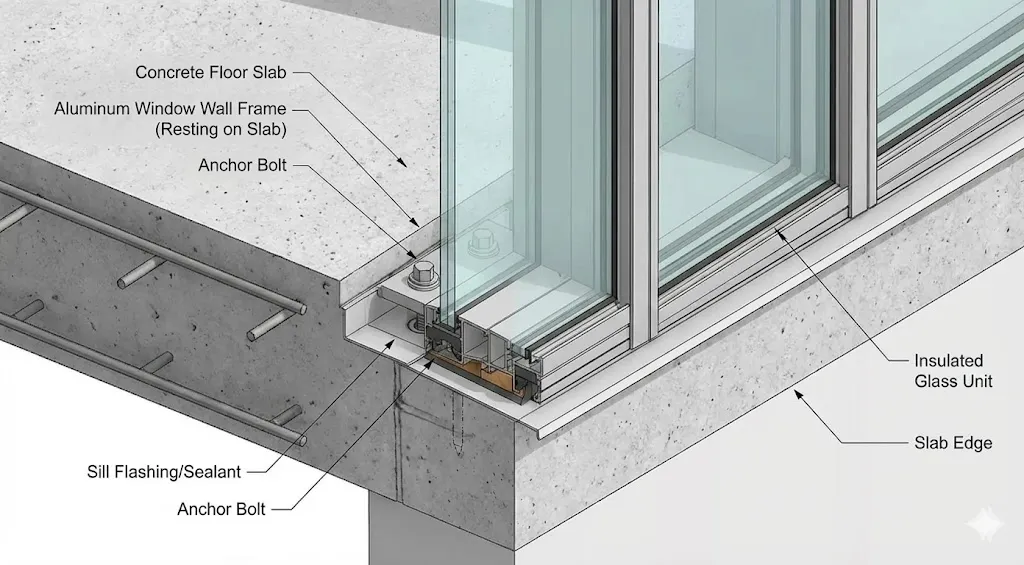
Window wall slab edge detail risk points are numerous. The system stops at the ceiling and starts again at the floor.
- 🚧The Gap: You must bridge the gap between units with a Slab Edge Cover (aluminum panel).
- 💧The Seal: You rely on two critical joints (head receptor and sill starter). If the window wall head detail at slab edge leakage risk is not managed, water flows directly into the unit below.
🏭 Factory Experience (10 Years Manufacturing)
“In my decade of overseeing production at APRO, the #1 issue I see with window wall orders isn’t the glass—it’s the slab edge covers. Architects often draw them as simple bent sheets. But if you don’t design a proper ‘receiver’ with a back-sealed gasket, that cover becomes a funnel for water. We always advise clients: don’t value-engineer the slab cover. It’s the only raincoat your concrete has.”
4. Thermal Bridging & Condensation
Because the concrete slab extends to the exterior in a window wall system, it acts as a massive thermal bridge. In cold climates, this creates a condensation risk at slab edge window wall mitigation becomes critical. Without a proper thermal break in the slab cover, you will get mold growth on the interior drywall near the floor.
⚖️ Who Owns the Risk? Scope & Responsibility Matrix
For a General Contractor, the facade responsibility matrix curtain wall vs window wall is the most important contract document.
1. Curtain Wall Scope of Work
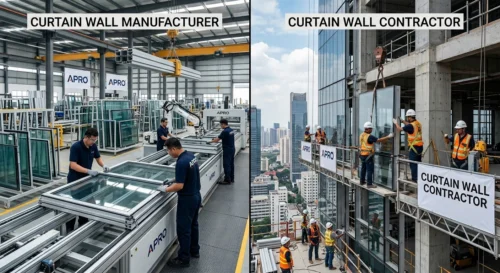
- 👷Subcontractor Role: Typically designs, supplies, and installs the entire envelope.
- 🔗Interfaces: Minimal. The sub is responsible for the glass, the aluminum, and the seals between them.
- 🎯Risk: Concentrated on one partner.
2. Window Wall Scope of Work
🧩 Fragmented Roles:
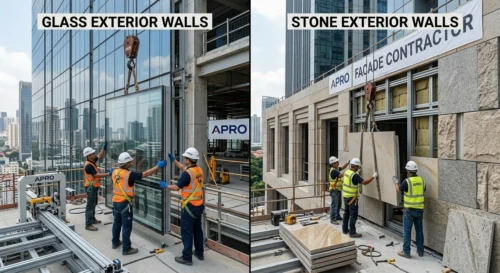
- Window Wall Contractor: Supplies and installs the glazing units.
- Waterproofing Contractor: Often applies the liquid membrane on the slab edge.
- Drywall/Interior Contractor: Builds the window wall interior finish interface gypsum board cover details.
- Firestopping Contractor: Who is responsible for slab edge firestopping curtain wall vs window wall? In window wall, this is often a separate trade filling the safing gap.
⚠️ Risk: High Interface Risk.
If it leaks at the floor line, the window guy blames the concrete guy, who blames the waterproofer.
💡 Pro Tip
To build GC trust builder credibility, define the curtain wall subcontractor vs window wall contractor responsibilities explicitly in the tender phase.
💧 Water Tightness & Field Testing: Where Leaks Happen
1. Which one leaks more (and why)?
Statistically, window wall leakage at slab edge common causes are the most frequent source of façade claims in residential towers.
2. Leakage Dynamics
Leaks usually happen at the Stack Joint (where vertical mullions meet) or due to curtain wall water leakage at mullion joints gasket failure.
Leaks happen at the marriage between the window sill and the concrete slab. If the slab is uneven (tolerance issues), the starter sill won’t seal.
3. Testing Protocols
You cannot rely on lab tests alone. You need field verification.
- 🚿AAMA 501.2 (The Hose Nozzle test): Great for checking static joints. Window wall interface testing slab edge AAMA 501.2 is essential before closing up walls.
- 💨ASTM E1105 (The Chamber test): This creates negative pressure to simulate wind-driven rain. It is the gold standard for ASTM E1105 field water penetration test curtain wall window wall verification.
4. Industry Case Study: Minerals Commission Office, Ghana
When APRO supplied the façade for the Minerals Commission Office in Ghana, we faced extreme tropical rain conditions. We utilized a unitized curtain wall system but implemented a rigorous field water testing workflow pass fail remediation facade plan.
💡 The Result: By testing the first 10 installed panels with AAMA 501.2, we identified a minor installation error in the spandrel zone before it was replicated across the building.
Read the full Project Case Study here: Minerals Commission Office Ghana Project
💰 Cost Analysis: Without Fixed Pricing
GCs always ask: “What is the price per square foot?” But curtain wall vs window wall cost analysis without fixed pricing is more valuable because it reveals the drivers.
1. The “Headline” Savings vs. Reality
According to recent industry whitepaper data, switching from curtain wall to window wall can save 15% to 30% on the initial façade contract value.
⚠️ Warning: This data often ignores the “hidden costs.”
2. Curtain Wall Cost Drivers (Visible)
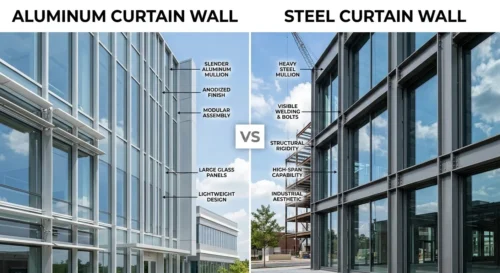
- 🏗️Materials: Higher aluminum weight (structural).
- 🚚Logistics: Curtain wall cost drivers material logistics hoisting are significant. You are shipping “air” with unitized panels.
- 🧗Access: Cranes, monorails, and swing stages are expensive line items in the GC’s general conditions.
3. Window Wall Hidden Costs (Invisible)
These window wall hidden costs slab edge covers firestopping interior finishes add up quickly:
- 🧱Slab Edge Covers: High-quality aluminum slab covers are expensive.
- 🔥Firestopping: Often excluded from the window bid.
- 🛠️Interior Finishes: You need to build a drywall pocket or sill to hide the window head/sill.
4. Value Engineering (VE) Do’s and Don’ts
- ✅ DO: Consider window wall vs curtain wall value engineering by using window wall on non-street-facing façades (e.g., courtyard side).
- ❌ DON’T: Try to reduce curtain wall cost without losing performance by thinning the aluminum profile below structural safety limits.
- ❌ DON’T: Skimp on window wall slab edge cover quality impact on cost and risk. A cheap bent sheet will oil-can (warp) and leak.
Want to source cost-effectively? Read our guide on:
How to Import Curtain Walls from China
🏗️ Installation Difficulty & Schedule Logistics
Curtain wall vs window wall installation difficulty and schedule is often the deciding factor for the project timeline.
1. Curtain Wall: The Critical Path
- 🏗️Hoisting: Curtain wall hoisting staging crane requirements are heavy. You need dedicated hook time.
- 🌬️Weather: Curtain wall vs window wall weather impact on installation is mixed. Unitized is fast, but high winds can shut down crane operations.
- 🧱Structure: Can proceed independently of the concrete pour (once anchors are set).
2. Window Wall: The Fast Track
- 🚀Sequence: Window wall installation sequence floor-by-floor fast track schedule allows the façade to follow the concrete crew closely. As soon as a floor is stripped and reshored, windows can go in.
- 🏢Access: Materials are loaded via buck hoist (elevator) and installed from the inside. No cranes needed.
- 🛡️Safety: Workers are behind safety distinct, reducing fall risks.
🏭 Factory Experience (Logistics)
“We once had a client in downtown Seattle switch from curtain wall to window wall purely because of wind. The tower crane was winded off 40% of the time. By switching to window wall, they could load panels at night via the internal hoist and install during the day regardless of wind speed. It saved them 2 months on the schedule.”
🔊 Acoustics & Ventilation
For high-rise residential, comfort is king.
1. Acoustic Performance (STC/OITC)
- 🏢Curtain Wall (Superior): Offers better vertical sound isolation. High facade OITC vs STC for high-rise residential window wall performance is easier to achieve with heavy glass and continuous frames.
- 🚧Window Wall (Weakness): The slab edge is a weak point for sound. Window wall lateral sound transmission slab edge issues occur when sound travels from one apartment to the one below through the concrete connection.
2. Ventilation Strategy
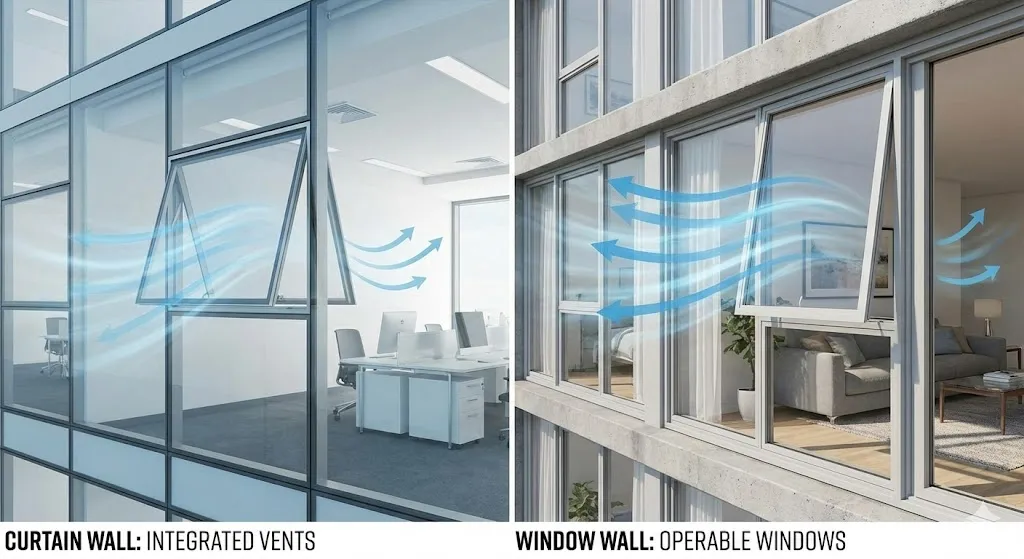
- ✅Window Wall (Easy): Easy to integrate operable window integration in window wall system (sliding doors, awning windows) because the frame is structurally compartmentalized.
- ⚠️Curtain Wall (Complex): Ventilation strategy window wall vs curtain wall operable vents is harder. In curtain walls, we use “Parallel Opening Windows” (POW) which are expensive and complex.
📋 A GC’s Decision Checklist: When to Choose Which?
Use this when to choose curtain wall vs window wall general contractor checklist for your next bid meeting.
✅ The Verdict Criteria
- 🏢
Height: Is the building > 20 floors?
Lean towards Curtain Wall(For wind load). - 🏗️
Balconies: Are there deep balconies?
Lean towards Window Wall(Construction challenges are lower; curtain wall handles balconies poorly). - ✨
Aesthetics: Does the architect demand a seamless glass skin?
Select Curtain Wall - 💰
Budget: Is the façade budget < $60/sqft?
Lean towards Window Wall - 🚧
Logistics: Is crane time limited?
Lean towards Window Wall - ⏱️
Schedule: Do we need to enclose floor-by-floor to start drywall early?
Lean towards Window Wall
📋 RFQ Pack for GCs: What to Ask Before Pricing
To get an accurate bid from a supplier like APRO, your facade bid package required drawings slab edge tolerance must be complete.
1. Curtain Wall RFQ Checklist
- Elevation drawings with module widths.
- Wind load report (kpa).
- Curtain wall mockup requirements and field testing requirements.
- Curtain wall RFQ checklist for subcontractor bids should include anchor type preferences.
2. Window Wall RFQ Checklist
- Window wall RFQ checklist slab edge details required. (Don’t leave this to the sub!).
- Slab edge tolerance specs (How flat is the concrete?).
- Slab cover finish requirements (PVDF vs Powder Coat).
- Shop drawing submittal checklist curtain wall window wall specific items.
Looking for reliable partners?
Check our list of Top 10 Curtain Wall Manufacturers in China
🎯 Conclusion
The choice between curtain wall vs window wall is not just about the price tag on the bid day. It’s about the lifecycle cost, the installation risk, and the final performance of the building.
For iconic towers, high performance, and seamless aesthetics.
For residential efficiency, fast-track scheduling, and budget management.
💡 The APRO Perspective
A curtain wall as a covering that keeps the weather out and occupants in. At APRO, we believe the right system is the one that keeps the water out and the project budget in check.
🚀 Ready to mitigate your façade risk?
Send your drawings and slab edge tolerance data to the APRO engineering team. We will provide a comparative analysis of curtain wall vs window wall cost specific to your project, ensuring you build with confidence.
❓ Frequently Asked Questions (FAQ)
1. Is a window wall considered a curtain wall?
According to the curtain wall vs window wall building code definition, no. A curtain wall must bypass the floor slab. A window wall sits between them. However, loosely speaking, both are considered building envelopes.
2. Unitized curtain wall vs window wall: which is better?
“Better” depends entirely on the goal:
- 🏢50-story Office: Unitized Curtain Wall is better for speed and performance.
- 🏠15-story Apartment: Window Wall is better for cost and balcony function.
3. Stick-built curtain wall vs window wall comparison?
Stick-built is assembled on-site (slow, labor-intensive) but flexible. Window wall is factory-glazed (fast) but segmented. Stick-built is rarely used for high-rise residential due to cost, whereas window wall dominates that sector.
4. How to handle typical failure points (Slab Edge Receiver)?
How to handle typical failure points window wall slab edge receiver sill detail?
🛡️ The Fix: Use a starter sill with an upstand leg (dam) that is sealed to the concrete with a liquid membrane before the window frame is installed.
5. What is the best facade system for high-rise residential?
Window wall is generally the industry standard for high-rise residential. It offers the best balance of cost, ease of balcony integration, and decent performance.



 English
  Arabic
  German
  Spanish
  French
  Italian
  Japanese
  Korean
  Portuguese
  Russian